Size and Growth Expectations for Arkansas Game Fish
One of the most thrilling parts of fishing in Arkansas is the sheer diversity and potential for size in our game fish. But beyond the excitement of a tug on your line, many anglers wonder: just how big do these fish really get, and what influences their growth? Understanding the typical size and growth expectations for species like bass, crappie, and catfish can dramatically improve your fishing strategy, help you appreciate conservation efforts, and give you a more realistic perspective on what you might reel in from our beautiful lakes and rivers. This guide will dive deep into the factors influencing fish growth and provide insights into the typical sizes you can expect from Arkansas's most beloved game fish.
Understanding Growth Factors for Arkansas Game Fish
When we talk about fish growing big, it’s rarely a simple matter of time. There’s a complex interplay of environmental conditions, genetics, and resource availability that dictates whether a fish reaches trophy size or remains on the smaller end of the spectrum. It’s a lot like gardening; you can plant the best seeds, but without good soil, water, and sunlight, they won't thrive.
Environmental Influences on Fish Size
The environment a fish inhabits plays an enormous role in its growth. Think about it: a small pond stocked with too many fish will produce stunted individuals, while a vast reservoir with abundant food and optimal temperatures can yield true giants. Water temperature, for instance, directly affects a fish's metabolism. Warmer waters generally mean faster metabolic rates, which can lead to quicker growth if food is plentiful. However, excessively hot water can also stress fish, slowing growth or even leading to mortality.
Beyond temperature, water quality is paramount. Clear, well-oxygenated water with a balanced pH creates a healthy environment where fish can feed and grow without constantly fighting off disease or stress. Pollution, sediment, or sudden changes in water chemistry can drastically impact a fish's ability to thrive. Factors like seasonal rainfall and drought can alter water levels, affecting access to spawning grounds or food sources, which in turn influences growth patterns. A consistent, stable environment is often key to sustained growth.
Genetic Predisposition and Hybrid Vigor
Just like in humans or livestock, genetics play a significant part in determining a fish's maximum growth potential. Some strains of fish are simply predisposed to grow larger and faster than others. This is particularly evident in stocking programs where agencies might introduce specific genetic lines known for their robust growth or disease resistance. When it comes to species like bass, certain populations in specific lakes consistently produce larger fish due to their genetic makeup.
Hybrid vigor is another fascinating aspect. This occurs when two different but closely related species interbreed, and their offspring often exhibit superior traits, including faster growth rates and larger ultimate sizes. For example, the hybrid striped bass, a cross between striped bass and white bass, is known for its aggressive feeding and rapid growth, making it a popular sport fish in many waters. These genetic factors, whether purebred or hybrid, lay the foundation for a fish's potential, but they still need the right environment to truly shine.
The Role of Forage and Habitat Quality
No matter how good the genes or how perfect the water, a fish simply won't grow without enough to eat. Forage—the available food sources—is perhaps the single most critical factor in growth. A lake teeming with baitfish like threadfin shad or gizzard shad will inevitably produce larger game fish than a lake with a sparse forage base. The type of forage also matters; high-protein diets lead to better growth. For instance, a diet rich in smaller fish helps predatory species like bass and catfish pack on pounds much faster than a diet consisting solely of insects or invertebrates.
Habitat quality goes hand-in-hand with forage. A healthy habitat provides not just food, but also shelter, spawning areas, and ambush points for predators. Submerged timber, rock piles, aquatic vegetation, and creek channels all create diverse microhabitats that support a rich food web. Lakes with abundant structure and diverse cover allow both prey and predator species to thrive, leading to a healthier ecosystem and, ultimately, larger game fish. Without quality habitat, even the most genetically blessed fish in the cleanest water will struggle to find enough food and cover to reach its full potential.
Common Arkansas Game Fish: Size and Growth Profiles
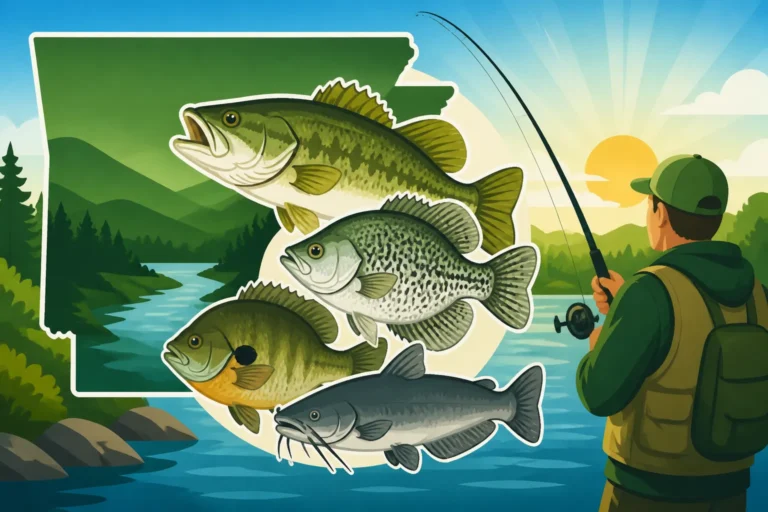
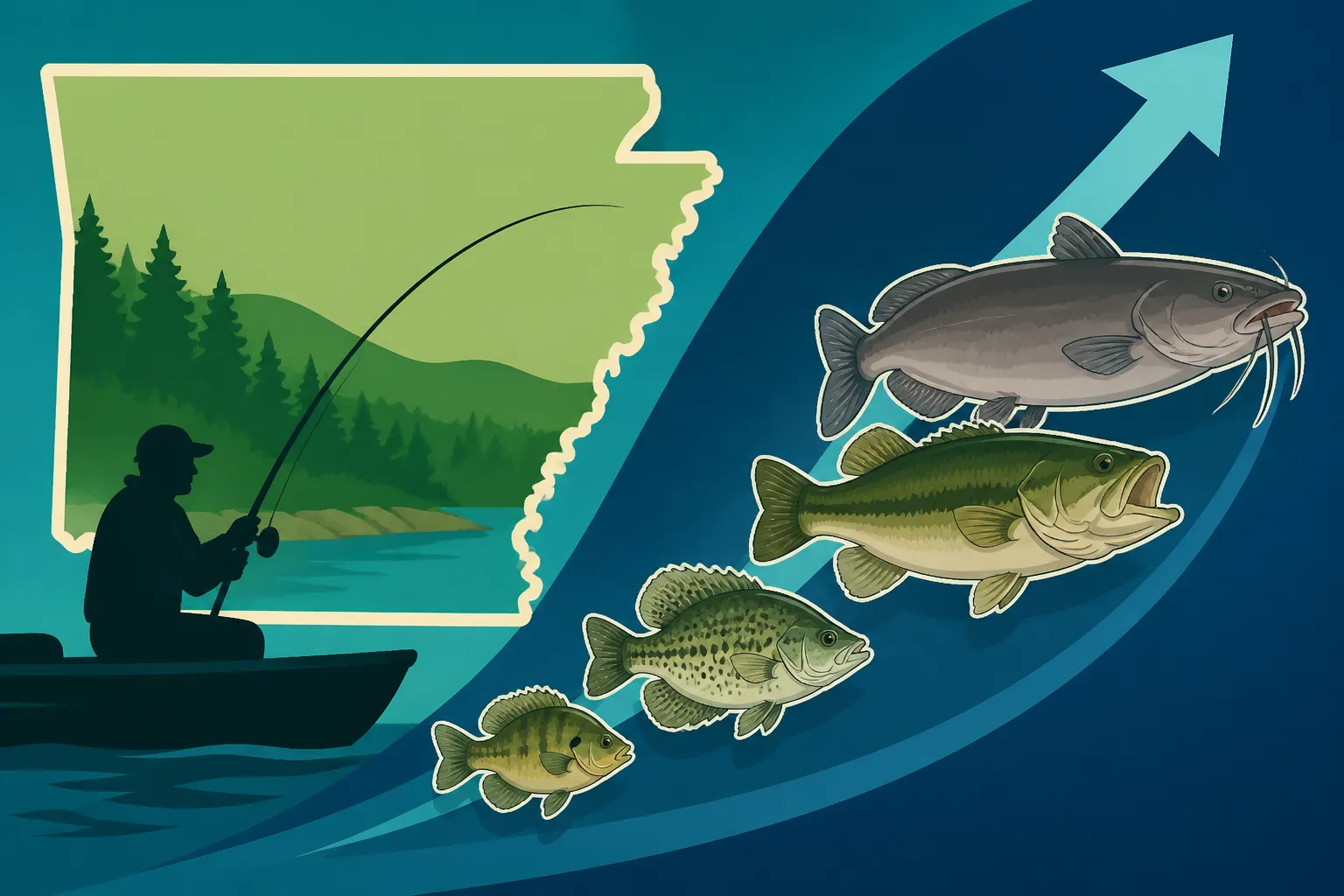
Arkansas is blessed with an incredible variety of game fish, each with its own typical size, growth rate, and potential for trophy catches. Knowing what to expect from these different species can really help you set your expectations and celebrate your catches, big or small! If you’re ever curious about the full list of species, check out Arkansas Fish Species: A Complete Guide to What's Swimming in Your Waters.
Largemouth, Smallmouth, and Spotted Bass
These three bass species are the superstars for many anglers in Arkansas. While they share the "bass" name, their growth patterns and typical sizes can differ quite a bit.
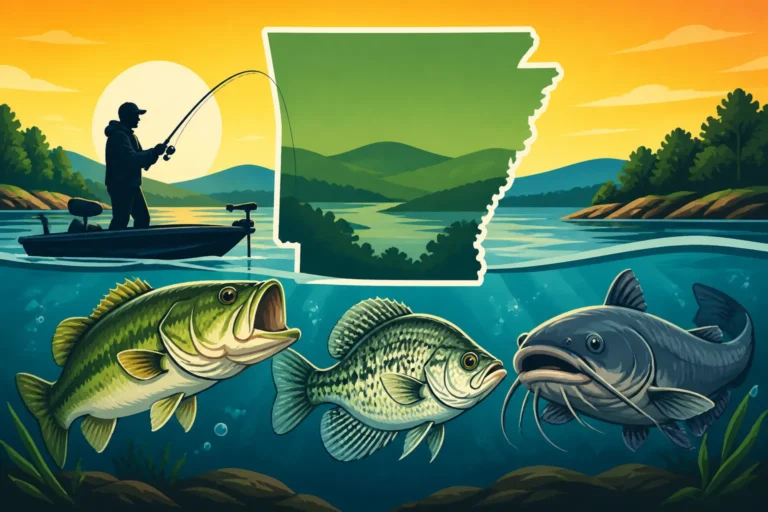
Largemouth Bass: The largemouth is arguably the most sought-after game fish in the state, known for its aggressive strikes and impressive size. In a healthy Arkansas lake with abundant forage like shad, sunfish, and crawfish, largemouth bass can grow quite quickly, often reaching 1-2 pounds within their first two to three years. After that, growth slows, but they continue to add weight and length, especially in trophy waters. A "good" largemouth in Arkansas is often considered anything over 3-4 pounds, while 5-8 pound fish are definitely trophies for most anglers. Double-digit fish (10+ pounds) are rare but absolutely possible, particularly in lakes like Lake Ouachita or Lake Conway. Their maximum lifespan can be 10-15 years, during which they can pack on significant size. Largemouth Bass Fishing on Arkansas's White River discusses some of these fish, though the White River is more known for its trout.
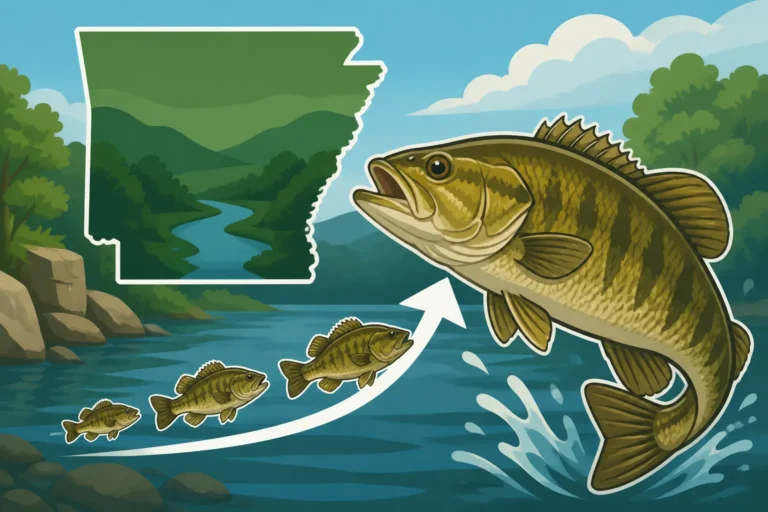
Smallmouth Bass: Known for their incredible fighting spirit and preference for clear, cool, rocky waters, smallmouth bass don't typically reach the same gargantuan sizes as largemouths, but they are still prized catches. In the Ozark streams and colder reservoirs like Bull Shoals or Norfork, a 1-2 pound smallmouth is a fantastic catch, and a 3-4 pounder is truly exceptional. Fish exceeding 5 pounds are rare giants that can take many years to grow. They tend to have a more elongated, muscular build compared to the largemouth's stockier profile. Their growth is often slower due to their colder water preference and sometimes less abundant, larger forage. If you're targeting these beauties, our guide on Smallmouth Bass in Arkansas's Ozark Streams has more specific details.
Spotted Bass (Kentucky Bass): Often confused with largemouths, spotted bass are common in many Arkansas reservoirs and rivers. They typically fall between largemouth and smallmouth in terms of maximum size. A common spotted bass might weigh 1-2 pounds, with a 3-pounder being a great fish. While they can occasionally reach 4-5 pounds, anything larger is extremely rare. They tend to grow a bit faster than smallmouths in many environments but don't have the same top-end potential as largemouths. They are, however, known for their strong fight for their size, making them a blast on lighter tackle. For more on these fish, check out Kentucky Bass (Spotted Bass) Fishing in Arkansas.
Crappie: Black and White Varieties
Crappie, both black and white, are immensely popular panfish in Arkansas, cherished for their delicious fillets and willingness to bite. While they might not be as huge as bass, a mess of big crappie is a fantastic day on the water.
Black Crappie: Generally, black crappie tend to be a bit stockier and sometimes grow slightly larger in certain conditions than white crappie, though this can vary wildly by water body. A "keeper" crappie in Arkansas is often around 9-10 inches, and anything 12 inches or longer is considered a really nice fish. They can reach weights of 1-2 pounds, with true slabs exceeding 2 pounds being the dream catch. They prefer clearer water with more vegetation than white crappie.
White Crappie: White crappie are often more prevalent in murkier, open waters of many Arkansas lakes and rivers. Like black crappie, a 9-10 inch fish is a good eater, and 12+ inches is a trophy. Their growth rates are similar, often reaching these sizes within 3-5 years under good conditions. White crappie can also hit the 1-2 pound mark, with the rare 3-pounder making anglers' hearts pound. The key for both species to achieve larger sizes is ample food and not being over-harvested. Understanding these nuances is crucial for chasing them, and you can learn more in Crappie Fishing in Arkansas: Black and White Crappie Basics.
Catfish: Channel, Blue, and Flathead
Catfish are the heavyweights of Arkansas waters, offering anglers the chance to hook into truly massive fish. Each of the three main species—channel, blue, and flathead—has distinct growth patterns and size potentials.
Channel Catfish: The most widespread and commonly caught catfish in Arkansas, channel cats are known for their distinctive forked tail. While they are often caught in the 1-5 pound range, especially in smaller ponds and rivers, they can grow much larger in larger reservoirs and commercial fisheries. Fish in the 10-20 pound range are not uncommon, and state records push well over 40 pounds. Their growth rate is moderate; a 1-pound fish can be a year or two old, while a 10-pounder might be 5-10 years old. They are prolific and adaptable, thriving in a variety of habitats. For specifics on these, refer to Channel Catfish in Arkansas Lakes and Rivers.
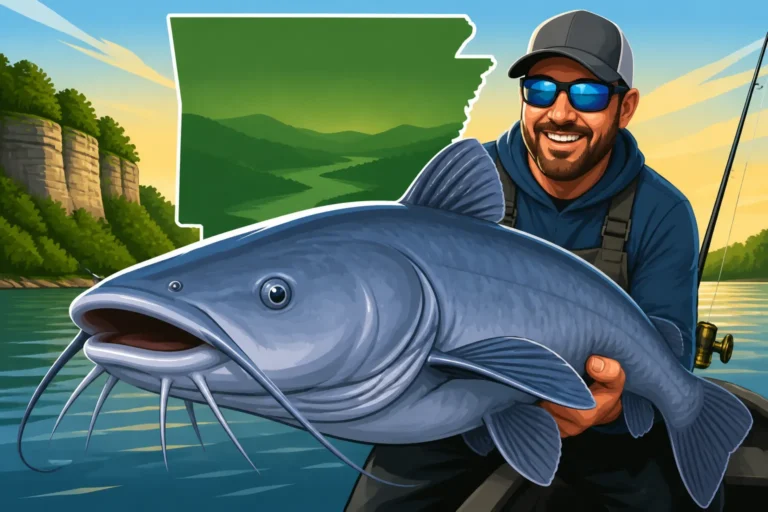
Blue Catfish: If you're chasing truly giant catfish, the blue cat is your target. These magnificent fish are built for size and power. While smaller ones are common, blue cats frequently reach weights of 20-50 pounds in large Arkansas rivers like the Arkansas River or in sprawling reservoirs. What makes them exceptional is their potential to grow well over 100 pounds, with state records pushing past 110 pounds! Their growth is impressive; a 10-year-old blue cat could easily be 30-40 pounds, and they can live for 20 years or more, continuing to grow throughout their lives. They are highly sought after by trophy anglers. For specific locations and techniques, see Blue Catfish Fishing in Arkansas.
Flathead Catfish: The flathead is a solitary, ambush predator with a distinctive flat head and lower jaw that protrudes beyond the upper. They are known for their preference for live bait and often inhabit areas with heavy cover. While not typically reaching the same extreme weights as blue catfish, flatheads are still massive fish, commonly caught in the 10-40 pound range. Fish over 50 pounds are considered trophies, and the state record is over 80 pounds. Their growth is slower than blue cats, but they can live for many years, slowly adding bulk. They are often found in larger rivers and the deeper, timber-filled sections of reservoirs. Learn more about these formidable fish in Flathead Catfish in Arkansas Waters.
Here’s a quick overview of typical sizes for these popular species:
| Species | Average Catch Size (pounds) | Trophy Size (pounds) | Average Length (inches) |
|---|---|---|---|
| Largemouth Bass | 1-3 | 5-8 | 12-18 |
| Smallmouth Bass | 1-2 | 3-4 | 10-15 |
| Spotted Bass | 1-2 | 3-4 | 10-16 |
| Black Crappie | 0.5-1 | 1.5-2 | 9-13 |
| White Crappie | 0.5-1 | 1.5-2 | 9-13 |
| Channel Catfish | 1-5 | 10-20 | 12-24 |
| Blue Catfish | 5-25 | 50+ | 20-40+ |
| Flathead Catfish | 5-20 | 40+ | 20-36+ |
| Rainbow Trout (stocked) | 0.5-2 | 3-5 | 10-18 |
| Brown Trout (wild) | 1-4 | 8-15+ | 14-24+ |
| Striped Bass | 5-20 | 30-60+ | 24-40+ |
Note: These are general expectations; individual fish size can vary greatly depending on the specific water body and conditions.
Arkansas's Trophy Fish Potential
Arkansas is absolutely a state where you can pursue and potentially catch the fish of a lifetime. Our diverse waters, from the cold-water tailwaters of the Ozarks to the warm, fertile lakes of the Delta, hold the potential for truly enormous game fish across many species. The dream of landing a record-breaker or a personal best keeps many anglers coming back season after season.
Record-Breaking Catches and Where They Come From
Arkansas has a storied history of producing incredible fish, and the state record book is testament to the trophy potential here. For instance, the state record blue catfish stands at an astounding 116 pounds! These record-breakers typically come from the larger river systems like the Arkansas River, or deep, productive reservoirs with a vast forage base and plenty of room to grow. Similarly, the White River is renowned for its monster brown trout, with fish consistently caught well over 10 pounds and the state record hovering around 40 pounds.
It's not just the big three (bass, crappie, catfish) either. Striped bass in lakes like Norfork and Hamilton can push 50-60 pounds, offering a fight that few other freshwater fish can match. These exceptional catches usually result from a combination of factors: excellent water quality, a rich and sustained food supply, unpressured fish that have lived a long life, and, of course, a little bit of luck on the angler's part. Often, these fish are caught by dedicated anglers who spend countless hours researching, scouting, and refining their techniques. You might be surprised at What is the Biggest Fish Ever Caught in Arkansas? to see the variety of huge fish.
Managing for Larger Fish: Regulations and Practices
Arkansas actively manages its fisheries to promote healthy populations and, in some cases, encourage trophy growth. This isn't just about letting fish get old; it's about creating conditions where they can thrive. Key tools in this management strategy include size limits and creel (daily bag) limits. For example, a minimum length limit means smaller fish are protected, allowing them to grow to a mature, spawning size, contributing to the population's health and increasing the chances of larger fish in the future.
Slot limits are even more specific, protecting both very small and very large fish, while allowing anglers to harvest fish within a certain "slot" or size range. This strategy is often used in trophy fisheries to protect the prime breeding stock (the large fish) and allow smaller fish to grow into the slot. These regulations, combined with responsible stocking programs and habitat restoration efforts, are critical for maintaining and enhancing Arkansas's reputation as a top fishing destination for large game fish. Understanding the Arkansas Fishing Regulations Guide is therefore essential for any angler.
Targeting Trophy Fish: Strategies and Gear
Chasing trophy fish is a different ballgame than simply catching a mess of eaters. It often requires specialized knowledge, patience, and robust gear. For example, to target a record blue cat, you'll need heavy-duty rods and reels, strong braided line, and substantial cut bait. For large brown trout on the White River, fly anglers might employ larger streamers or nymph patterns, while spin fishermen might use larger, heavier spoons or stickbaits. The common thread is upscaling your tackle to handle the increased size and power of these larger fish. You can find many specialized lures and baits on Amazon that cater to trophy hunting.
Trophy hunting also involves a deep understanding of fish behavior. Big fish are often older, wiser, and more wary. They tend to live in specific, productive areas that offer both food and cover, and they often feed during particular times or under certain conditions. This means less random casting and more deliberate, focused effort. Anglers often employ techniques like slow trolling large baits, live bait rigging, or long hours of casting to specific structure. Researching the specific lake or river you're fishing and understanding the seasonal patterns of trophy fish are crucial. Consider that Best Bait and Lures for Arkansas Bass might be different for a 2-pounder versus a 10-pounder.
Age and Growth Rate: What to Expect
Understanding how quickly a fish grows and how its age relates to its size can be fascinating and highly informative for anglers. It provides insight into the health of a fishery and helps manage expectations. Not all fish grow at the same pace, and even within the same species, factors can cause significant variations.
Fast-Growing vs. Slow-Growing Species
In Arkansas waters, you'll encounter a wide range of growth rates. Generally speaking, some species are known for rapid growth, while others take their time to pack on the pounds. For instance, striped bass are incredibly fast growers, especially in productive impoundments like Norfork Lake or Lake Hamilton. They can reach double-digit weights within just a few years, making them an exciting species for anglers looking for a substantial fight relatively quickly. This fast growth is largely due to their predatory nature and often abundant forage base of shad. Learn more about Trophy Striped Bass Fishing in Arkansas if you're interested in these fast-growing giants.
On the other end of the spectrum, species like trout, particularly wild brown trout in tailwaters, often exhibit slower, more consistent growth. While stocked rainbow trout can grow rapidly in the right conditions, a wild brown trout in a cold, clear river might take several years to reach just a few pounds. Their colder environment slows their metabolism, and their diet may consist of smaller aquatic insects and crustaceans. Even within a species, different populations might grow at varying rates depending on local conditions. A largemouth bass in a nutrient-rich farm pond might outgrow its counterpart in a less fertile mountain lake in the same amount of time.
How Age Relates to Length and Weight
There's a strong, though not perfectly linear, relationship between a fish's age, its length, and its weight. Younger fish tend to grow quickly in length, then as they mature, their growth shifts more towards adding girth and weight rather than just getting longer. Think of it like a teenager shooting up in height versus an adult gaining muscle mass. For example, a 1-year-old largemouth bass might be 8-10 inches long and less than a pound. By age 3, it could be 14-16 inches and 2-3 pounds. But a 10-year-old bass might only be 20-22 inches, yet weigh 6-8 pounds, having added significant bulk without much extra length.
This age-to-size relationship is crucial for fishery managers. By sampling fish and determining their age (often through scale or otolith analysis), they can assess the overall health of a fish population. If fish are growing slowly for their age, it might indicate overpopulation, insufficient food, or poor water quality. Conversely, rapid growth for age suggests a healthy, productive environment. As an angler, knowing these general trends helps you understand why some of the truly massive fish you catch are also very old.
Reading Growth Rings and Scale Analysis
How do we actually figure out a fish's age? One of the most common and fascinating methods is through scale analysis. Just like trees have annual growth rings, fish scales develop growth rings called "annuli." During periods of rapid growth (typically spring and summer), the growth rings are widely spaced. During slower growth periods (like winter), the rings are much closer together, forming a distinct band that marks a year's growth. By examining these annuli under a microscope, biologists can accurately count a fish's age. This is usually done by removing a few scales from the fish's side, often near the dorsal fin, and examining them in a lab.
Another method, particularly for species with fewer or smaller scales or for older fish, involves analyzing otoliths (ear bones). Otoliths also lay down annual growth rings and provide an even more accurate record of a fish's life history. While these methods are typically performed by professionals, the underlying principle is a testament to nature's intricate record-keeping. It's a powerful tool for understanding population dynamics and growth rates across different species and water bodies, informing the regulations that help ensure our fisheries remain vibrant.
Conservation and Sustainable Growth
As anglers, we all have a role to play in ensuring that Arkansas's fish populations remain healthy and continue to produce impressive fish for generations to come. Sustainable practices are not just good for the environment; they directly impact the size and growth potential of the fish we love to catch.
The Importance of Slot Limits and Creel Limits
Regulations like slot limits and creel limits are cornerstones of modern fisheries management in Arkansas. They are designed not just to limit harvest, but to shape the population structure for optimal health and growth.
Creel limits, or daily bag limits, restrict the number of fish an angler can keep per day. This prevents overfishing, especially of popular species, and ensures that enough fish remain in the water to spawn and contribute to future generations. Without these limits, even a healthy population could be quickly depleted by too much harvest pressure. Imagine if there were no limits on crappie; a few dedicated anglers could decimate a population in a short time.
Slot limits are more nuanced. Instead of just a minimum size, they often designate a range of sizes that cannot be kept. For example, a lake might have a slot limit on bass where you can keep fish under 12 inches or over 16 inches, but nothing in between. The "slot" of 12-16 inches are protected. This strategy is excellent for promoting trophy fisheries because it protects the middle-aged, fastest-growing fish, allowing them to reach larger sizes, and also safeguards the largest, most productive spawning fish. These larger fish are vital for passing on their "big fish" genes. By understanding and adhering to these rules, anglers directly contribute to the growth and abundance of our favorite game fish.
Catch and Release Practices for Future Growth
Catch and release has become a widely accepted and often encouraged practice, especially when targeting larger, trophy-sized fish or during specific seasons. Releasing a fish, particularly a healthy, larger one, allows it to continue growing and, crucially, to participate in future spawning events. A big female bass or crappie can lay tens of thousands of eggs, so allowing her to reproduce is a direct investment in the future of the fishery.
However, proper catch and release techniques are vital to ensure the fish's survival. This means minimizing handling time, using wet hands to protect the fish's slime coat, using barbless hooks or de-barbing hooks to make removal easier, and reviving exhausted fish before releasing them. Deep-hooked fish or those bleeding heavily may have a lower chance of survival, so sometimes it's more ethical to harvest them if legal. Many tournament anglers and trophy hunters practice catch and release religiously, often getting a quick photo and then carefully returning the fish to the water to fight another day. It's a powerful way to ensure sustainable growth and future opportunities for impressive catches.
Habitat Improvement and Stocking Programs
Beyond regulations, active management efforts significantly contribute to fish growth and overall fishery health.
Habitat improvement is a proactive measure that directly influences how well fish can feed, spawn, and grow. This can involve sinking artificial structures like brush piles or rock piles to create cover for both baitfish and predatory game fish. Protecting and restoring natural aquatic vegetation, managing shoreline erosion, and improving water quality through watershed management are all critical. These efforts create healthier, more productive environments where fish have access to ample food and shelter, which are fundamental to achieving their full growth potential. If a lake has fantastic habitat, it’s much more likely to produce larger fish.
Stocking programs, carried out by the Arkansas Game and Fish Commission, are another key tool. While not a replacement for healthy natural reproduction, stocking can supplement fish populations, introduce new genetic material, or re-establish species in waters where they've declined. For example, trout are regularly stocked in Arkansas's cold tailwaters to support the popular trout fisheries. In some lakes, fingerling bass or crappie might be stocked to boost populations after a tough spawning year or to introduce strains with better growth potential. Careful stocking ensures that fish have a head start and contribute to the overall biomass, ultimately enhancing the chances for anglers to catch good-sized fish. These combined efforts are what make Arkansas a premier fishing destination.
Practical Tips for Estimating Fish Size
Even if you're practicing catch and release, knowing a fish's approximate size is part of the fun! It's how we compare catches, keep track of personal bests, and generally brag (responsibly, of course!). Plus, it's essential for adhering to those all-important length limits.
On-the-Water Measurement Techniques
Getting an accurate measurement of your catch on the water is easier than you might think, and there are several simple tools to help. The most straightforward is a fish measuring board or ruler. These are typically flat, plastic devices with a ruler printed on them, often with a raised end to butt the fish's snout against for an accurate length. You can find many affordable options on Amazon, or at any local tackle shop. Simply lay the fish gently on the board, ensuring its mouth is closed and against the stop, and note the length to the tip of the tail. For longer fish, a flexible tape measure works, but be careful to keep the fish still.
For weight, a digital fishing scale is your best friend. Modern digital scales are compact, accurate, and can weigh fish quickly. Many even have a "hold" function that locks in the weight, so you don't have to squint while a fish wiggles. Always zero out your scale before use, and try to support the fish's weight as much as possible, especially larger ones, to avoid injuring its jaw or internal organs if you're planning to release it. Using a lip gripper with a built-in scale can be convenient, but again, ensure the fish is well supported. Practice these techniques even on smaller fish so you're ready when that monster bite happens!
Using Reference Charts and Apps
Beyond direct measurement, having reference charts or even smartphone apps can be incredibly helpful for estimating weight based on length, or vice-versa. Many fish species have well-established length-to-weight ratios. While not perfectly precise for every individual fish (some are fatter, some are leaner), these charts provide a good estimate. For example, a 16-inch largemouth bass might typically weigh around 2-3 pounds, depending on its condition. A 12-inch crappie could be around 1.5 pounds.
There are numerous apps available on your phone that can do these calculations for you; you simply input the length, and the app provides an estimated weight. You can also print out small laminated cards with these charts to keep in your tackle box or boat. These tools are fantastic for when you want a quick estimate without having to handle the fish extensively, particularly if you’re dedicated to catch and release. They empower you with information, making you a more knowledgeable angler and helping you interpret what a specific length truly means in terms of a fish's potential size.
How to Safely Handle Large Fish
Catching a truly large fish is an exhilarating experience, but handling it correctly is paramount, especially if you plan to release it. Mishandling can cause injury, stress, or even delayed mortality, negating the purpose of catch and release.
First, minimize fight time by using appropriate tackle that allows you to land the fish relatively quickly without totally exhausting it. Once landed, keep the fish in the water as much as possible. If you need to bring it aboard for a photo or measurement, do so quickly. Use a wet hand or wet glove when touching the fish to protect its delicate slime coat, which is a crucial barrier against infection.
Support the fish's full weight. Never hold a large fish purely by its jaw or tail without supporting its belly, as this can cause severe damage to its internal organs or spinal column. For heavy fish, cradling its body with one hand while supporting the jaw (for bass) or the tail (for catfish) is ideal. If a fish is exhausted, hold it gently in the water, facing into a mild current if possible, until it kicks strongly and swims away on its own. For very large catfish, a strong net or specialized landing mat might be necessary to protect both you and the fish. Being prepared with the right tools and knowledge for safe handling ensures that Arkansas's big fish can continue to grow and contribute to our fantastic fisheries.
Disclaimer
This article is for general informational purposes only and does not constitute professional advice. Laws, prices and regulations vary by location and change over time. Consult a qualified professional for guidance on your specific situation.