Kentucky Bass (Spotted Bass) Fishing in Arkansas
Many anglers in Arkansas, especially those new to our diverse waters, often find themselves scratching their heads when trying to identify the bass they just caught. Is it a largemouth, a smallmouth, or something else entirely? This confusion often centers around the elusive, yet abundant, Kentucky bass, also widely known as the spotted bass. This comprehensive guide aims to clear up that mystery, providing you with everything you need to know about targeting and understanding this incredible game fish in Arkansas.
Understanding the Kentucky Bass (Spotted Bass)
The Kentucky bass, or spotted bass as it's often called, is a fantastic game fish that offers a unique challenge and thrill to anglers across Arkansas. While they might bear a superficial resemblance to their largemouth and smallmouth cousins, these fish have distinct characteristics and behaviors that make them a species all their own. Getting to know these nuances is the first step to consistently hooking into them.
What Makes a Kentucky Bass Unique?
At first glance, a Kentucky bass can easily be mistaken for a largemouth, especially if you're pulling it from a brush pile in murkier water. However, there are a few key identifiers that, once you learn them, make spotting a spotted bass a breeze. The most prominent feature is the row of distinct dark spots along its lower side, below the lateral line, which gives it its common "spotted bass" moniker. These spots are usually much clearer and more defined than any faint markings you might see on a largemouth.
Another crucial identifier is the patch of teeth on its tongue. If you gently open the fish's mouth and run your finger across its tongue, you'll feel a rough patch on a Kentucky bass. This is a dead giveaway, as neither largemouth nor smallmouth bass possess this unique dental feature. Also, pay attention to the jawline. On a Kentucky bass, the upper jaw typically extends to the middle of the eye or just slightly beyond, whereas on a largemouth, it extends well past the eye. On a smallmouth, it usually doesn't reach the back of the eye at all. The body shape tends to be more slender and torpedo-like than a largemouth, but not quite as robust as some smallmouth. They strike a nice balance between the two, making them powerful fighters for their size. If you're still unsure, check out How to Tell a Kentucky Bass from a Largemouth for a detailed comparison.
Where Kentucky Bass Thrive in Arkansas
Kentucky bass aren't as picky about water clarity as smallmouth, but they do prefer waters with a bit more current and rocky structure than largemouth typically inhabit. In Arkansas, you'll find them abundant in our large impoundments with rocky shorelines, deep points, and standing timber, especially in areas where there's some flow. They really love the transition zones – places where a creek channel meets the main lake, or where rock bluffs give way to flatter banks.
They tend to suspend more often than largemouth, especially over deeper water and around baitfish schools. This means your electronics can be a huge asset in locating them. Unlike largemouth, which prefer dense vegetation and shallow cover, Kentuckies are often found relating to submerged timber, humps, and ledges in deeper water. They're also quite comfortable in the clear, moving waters of certain rivers and streams, though perhaps not as prevalent as true smallmouth in those extreme environments. Their adaptability is one of their strongest traits, allowing them to occupy a broad range of habitats.
Growth and Size Expectations
While Kentucky bass don't typically reach the behemoth sizes of trophy largemouth, they certainly hold their own in terms of fighting power per pound. A common Kentucky bass in Arkansas will often weigh between 1 to 3 pounds. However, don't let that fool you into thinking they can't get bigger! Four to five-pound Kentuckies are not uncommon, and anything over that is considered a true trophy. The state record in Arkansas for a Kentucky bass is quite impressive, demonstrating their potential.
These fish are known for their incredibly hard fighting style. When you hook a Kentucky bass, expect aggressive runs, powerful headshakes, and often acrobatic jumps. They fight dirty, diving into cover and trying to wrap you around anything they can find. This makes them an absolute blast to catch on lighter tackle. Their growth rate is influenced by their environment, including food availability, water temperature, and population density. In nutrient-rich reservoirs with ample forage, they can grow quite quickly. For details on how big these fish can get, you might want to look at Kentucky Bass Size Records in Arkansas.
Prime Locations for Kentucky Bass in Arkansas
Arkansas is blessed with a fantastic variety of fishing waters, and many of them hold thriving populations of Kentucky bass. Knowing where to start your search is half the battle, and understanding why these spots are productive will help you develop a keen eye for finding them yourself.
Key Rivers and Streams
While smallmouth bass often dominate the discussion when it comes to Arkansas rivers, Kentucky bass also make a strong showing in many of our moving waters, particularly in the foothills and transitional zones between the mountains and the flatter delta. Rivers like the upper Arkansas River and its tributaries, especially those with some rock and gravel bottom interspersed with deeper pools, can be fantastic for spotted bass. They appreciate the slightly less turbulent, but still oxygenated, waters.
Look for areas with current breaks: eddies behind large rocks, submerged logs, or bluff walls where the current slows just enough for them to ambush prey without expending too much energy. Feeder creeks entering larger rivers are also prime targets, especially after a rain when they bring in new food sources. These areas often have a mix of rock and gravel bottoms, which Kentucky bass prefer for both foraging and spawning. Unlike the true smallmouth strongholds of the clear, fast-flowing Ozark streams, Kentuckies are more adaptable to slightly warmer, larger river systems that still offer good structure.
Top Lakes and Reservoirs
Arkansas's large impoundments are arguably the most consistent places to find robust populations of Kentucky bass. Lakes like Beaver Lake, Greers Ferry Lake, Bull Shoals Lake, and Norfork Lake are absolute hotspots. These lakes all share common characteristics: deep, clear to moderately clear water, abundant rocky structure (bluffs, points, humps), and plenty of submerged timber. Best Bass Lakes in Arkansas often feature these waters for a good reason.
On these lakes, Kentucky bass will relate heavily to main lake points, especially those with steep drops or shelves. They love humps and offshore structure that top out in 15-30 feet of water, often suspending just above the structure waiting for baitfish. Dam areas and the tailwaters below them can also be productive, as the increased current and oxygen levels attract baitfish and, consequently, hungry bass. Don't overlook large creek channels that wind through the lake, particularly where they meet the main river channel. These "highways" for baitfish are also prime travel routes and ambush points for Kentucky bass.
Finding Their Hideouts
Kentucky bass are master ambush predators, and they excel at using structure and cover to their advantage. When you're on the water, think about places where a Kentucky bass can easily hide and dart out to grab a meal. This often means rock piles, especially those with larger boulders creating small crevices and ledges. Best Bass Fishing Spots on Bull Shoals Lake will highlight exactly this kind of cover.
Deep points and humps are crucial, but also look for isolated submerged timber or brush piles in deeper water. These aren't always visible, so a good fish finder is invaluable. Kentucky bass will position themselves strategically, often on the shady side of a brush pile or slightly off the main point, waiting for shad or other baitfish to swim by. During colder months, they'll often stack up on deep vertical structure, like bluff walls or submerged trees, seeking stable water temperatures. In warmer months, they might move shallower during low light conditions but will typically retreat to deeper, cooler water as the sun climbs high.
Effective Techniques for Catching Kentucky Bass
Catching Kentucky bass can be incredibly rewarding because they are aggressive biters and tenacious fighters. However, their preferences for certain lures and their seasonal movements mean you need a varied approach. Having the right tools and knowing how to use them will make all the difference.
Lures and Baits They Can't Resist
Kentucky bass are not overly finicky, but they do have their favorites. Since they often suspend and feed on shad, baits that mimic these baitfish are incredibly effective.
- Jigs: A jig is almost always a good choice for spotted bass. Football jigs or finesse jigs, especially in colors like green pumpkin, brown, or black and blue, worked along rocky bottoms and ledges, can be deadly. Tip them with a small creature bait or a chunk trailer for added bulk and action.
- Drop Shots: When fish are suspended or holding tight to vertical cover, a drop shot rig with a small, straight-tail worm or soft plastic minnow imitation can be irresistible. This allows you to present a bait at a precise depth and keep it there.
- Carolina Rigs: For covering larger areas of deeper structure, a Carolina rig with a lizard or soft plastic creature bait dragged slowly across the bottom is a fantastic option. The leader length allows the bait to float tantalizingly above the bottom, mimicking an easy meal.
- Crankbaits: Deep-diving crankbaits are excellent for targeting Kentuckies on main lake points and humps. Choose colors that imitate shad or crawfish, and try to make contact with the bottom or submerged timber to trigger reaction strikes.
- Swimbaits: Small paddle-tail swimbaits, either rigged on a jig head or as a trailer on an underspin, are fantastic for mimicking shad. They can be retrieved at various depths, making them versatile for suspended fish or those relating to structure. You can find a huge selection of these on Amazon, often with great deals.
- Topwater: Don't forget topwater lures, especially during low light conditions or when fish are actively schooling. Walking baits or poppers can entice explosive strikes from aggressive Kentucky bass.
For more specific recommendations, refer to Best Bait for Spotted Bass.
Seasonal Strategies
Kentucky bass behavior changes significantly with the seasons, much like other bass species.
- Spring: As water temperatures begin to rise, Kentucky bass move shallower, though usually not as shallow as largemouth. They’ll be found on secondary points and gravel banks preparing for the spawn. Jerkbaits, crankbaits, and spinnerbaits are very effective. The pre-spawn period offers some of the best fishing opportunities.
- Summer: During the heat of summer, Kentuckies retreat to deeper water, often suspending over offshore humps, ledges, and deep creek channels. They will follow baitfish schools. Look for them early and late in the day on topwater, or fish deep with drop shots, jigs, and spoons during midday. Deep-diving crankbaits are also excellent for trolling along deep contours.
- Fall: As water temperatures cool and baitfish move shallower, Kentucky bass follow suit, often schooling aggressively. This is a prime time for throwing smaller swimbaits, topwater lures, and spinnerbaits near points and pockets. Keep an eye out for active schools busting bait on the surface!
- Winter: In winter, Kentucky bass will hold tight to deep, vertical structure like bluff walls, submerged trees, and bridge pilings. They become less active, so slow presentations with jigs, spoons, and subtle soft plastics like a Ned rig are key. Vertical jigging a spoon directly over suspended fish can also be deadly.
Understanding Arkansas Bass Spawn Timing by Water Temperature will give you an edge in spring.
Gear Recommendations
Choosing the right gear is essential for effectively targeting Kentucky bass, especially given their hard-fighting nature. A medium-light to medium power spinning rod, typically 6'6" to 7' in length, paired with a 2500 or 3000 size spinning reel is a versatile setup. This combination offers enough backbone to handle their powerful runs but is sensitive enough to detect subtle bites. For line, 8-10 lb fluorocarbon or braided line with a fluorocarbon leader is a popular choice. Fluorocarbon offers excellent sensitivity and abrasion resistance, while braid provides incredible strength and casting distance, especially useful when paired with a leader.
For lures like jigs, Carolina rigs, and deep-diving crankbaits, a medium-heavy baitcasting setup might be preferred for better control and power. A 7' medium-heavy rod with a high-speed reel (7.0:1 or higher gear ratio) spooled with 12-17 lb fluorocarbon line is a solid option. Having a variety of rods rigged with different baits means you can quickly switch presentations to match the fish's mood. Don't forget a good pair of pliers for hook removal and a net to safely land your catch. You can find high-quality fishing rods, reels, and tackle bags from various brands on Amazon, often with detailed reviews to help you choose. For beginners, a combo kit from Amazon can be a great way to get started without breaking the bank.
Kentucky Bass Behavior and Best Practices
To truly become proficient at catching Kentucky bass, it's not enough to just know where they live or what lures they strike. Understanding their fundamental behaviors, from how they reproduce to what they eat, will allow you to predict their movements and feeding patterns, significantly improving your success rate. Moreover, practicing responsible angling ensures these fantastic fish remain abundant for generations to come.
Spawning Habits and Timing
Kentucky bass typically spawn a little later than largemouth bass, usually when water temperatures reach the mid-60s Fahrenheit. In Arkansas, this generally occurs from late April through May, sometimes extending into early June depending on the specific body of water and weather patterns. Unlike largemouth, which often seek out shallow, vegetated flats, Kentucky bass prefer harder bottoms for their nests. They'll often build their beds on gravel points, rocky banks, or even submerged logs in water ranging from 5 to 20 feet deep, favoring areas with some current or wave action.
The male bass guards the nest fiercely, fanning the eggs to keep them oxygenated and protecting the fry once they hatch. During this time, they can be highly aggressive, striking at anything that comes too close to their nest. This makes them vulnerable to anglers, so practicing catch and release during the spawn is highly recommended to protect the future of the fishery. Targeting them slightly deeper in the pre-spawn period, when they're actively feeding and staging, can be a more sustainable approach.
Feeding Patterns and Preferred Forage
Kentucky bass are opportunistic predators with a diet that primarily consists of baitfish like shad, shiners, and juvenile sunfish. However, they're not above munching on crawfish, insects, and even smaller frogs or salamanders when available. Their feeding patterns are heavily influenced by the availability and movement of their prey. When baitfish are schooling in open water, Kentucky bass will often school up and actively chase them, making for exciting topwater or swimbait action.
They are known for their strong schooling tendencies, much like white bass or striped bass, especially in open water. This means if you catch one, there are likely many more nearby. They're also skilled at ambushing prey from cover. A Kentucky bass will often sit perfectly still behind a rock or submerged log, waiting for an unsuspecting baitfish to swim by before launching a lightning-fast attack. Understanding what they're eating at any given time can help you select the most effective lures and retrieve patterns. If shad are prevalent, "shad-colored" baits are often the ticket. If crawfish are abundant, brown or green pumpkin jigs become irresistible.
Conservation and Responsible Angling
Arkansas boasts incredible fishing resources, and it's up to us, as anglers, to protect them. Practicing responsible angling techniques is crucial for maintaining healthy Kentucky bass populations. Catch and release is a cornerstone of this, especially for larger breeding-size fish. If you do plan to keep fish for a meal, be sure to understand and adhere to all local regulations regarding Arkansas Fish Size and Daily Limits. Always check the specific rules for the water you're fishing, as limits can vary by lake or river.
When practicing catch and release, handle the fish carefully. Wet your hands before touching them to protect their protective slime coat. Use de-hooking tools if the hook is deep, and avoid excessive handling. If the fish is exhausted from the fight, take time to revive it by holding it gently in the water, facing into any current, until it can swim away under its own power. Proper fish care ensures that these resilient fighters can continue to thrive and provide future angling opportunities for everyone.
Comparing Kentucky Bass to Other Arkansas Bass Species
Arkansas is home to a magnificent array of bass species, each with its own unique charm and angling challenge. While all bass offer a thrilling fight, understanding the subtle differences between Kentucky bass, largemouth bass, and smallmouth bass can dramatically improve your success rate and appreciation for these distinct fish. Knowing which species you're targeting allows you to adjust your tactics and increase your chances of a rewarding day on the water. For a comprehensive comparison, see How to Tell Largemouth, Smallmouth, and Kentucky Bass Apart.
Kentucky vs. Largemouth Bass
The most common point of confusion for anglers in Arkansas is distinguishing between a Kentucky bass and a largemouth bass. They often share similar habitats, particularly in the clearer sections of our large reservoirs. However, their physical differences and preferred behaviors are quite distinct.
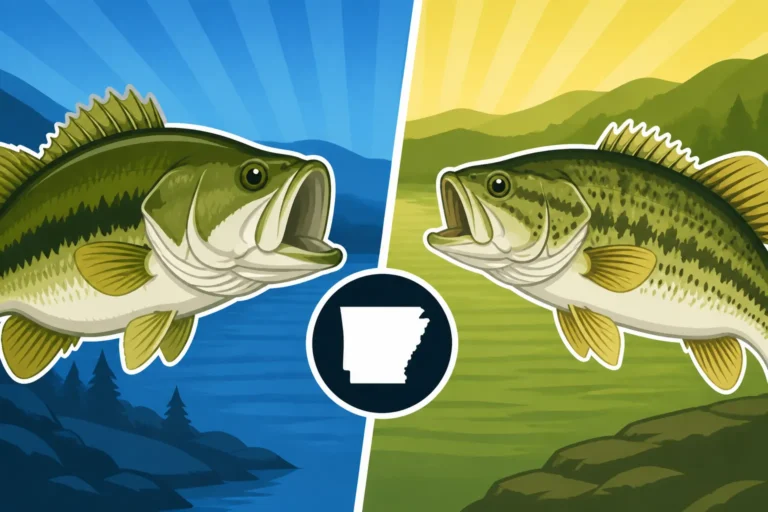
As mentioned earlier, the key visual differentiator for a Kentucky bass is the patch of rough teeth on its tongue and the rows of distinct spots below its lateral line. A largemouth, conversely, will have a smooth tongue and a dark, unbroken lateral stripe rather than distinct spots. The largemouth's jaw also extends noticeably beyond the eye, while the Kentucky bass's jaw typically stops at or just behind the eye. In terms of body shape, largemouth tend to be chunkier and more football-shaped, especially when mature, while Kentuckies are usually more slender.
Behaviorally, largemouth bass are typically more associated with dense cover like lily pads, hydrilla, submerged timber, and shallow weed lines. They are ambush predators that thrive in thick vegetation and muddy water. Kentucky bass, while they will use timber, prefer more open water structure like rocky points, humps, and ledges in deeper, clearer sections of lakes or rivers. Largemouth are known for their powerful initial surge and headshakes, often trying to bury themselves in cover. Kentucky bass, while also powerful, are more inclined to make repeated, hard runs and spirited jumps, often fighting with a more sustained, "never give up" attitude in open water.
Kentucky vs. Smallmouth Bass
Comparing Kentucky bass to smallmouth bass brings us to another fascinating distinction, particularly in the Ozark region of Arkansas where smallmouth reign supreme in many of the clearer, flowing waters. While both prefer rocky habitats and often overlap in large reservoirs, their primary riverine preferences differ. Smallmouth Bass Fishing in Arkansas's Ozark Rivers will show you where the smallmouth truly shine.
Physically, smallmouth bass are easily identified by their vertical bars or blotches on their sides, often described as tiger stripes, and their eyes are typically red. Their jawline rarely extends past the middle of the eye. They also lack the distinctive spotted pattern and the rough tongue of the Kentucky bass. Smallmouth tend to be more bronze or brownish in color, adapting perfectly to the rocky, gravelly bottoms of their preferred clear streams and rivers.
Behaviorally, smallmouth are the undisputed kings of river current, thriving in rapids, shoals, and swift-moving riffles. They are incredibly powerful swimmers and are renowned for their aggressive strikes and spectacular acrobatic jumps. Kentucky bass, while they appreciate some current, generally prefer larger rivers with a bit more depth and less extreme flow than a typical smallmouth river. In lakes, smallmouth are often found on offshore rock piles, deep humps, and steep bluffs in the clearest parts of the reservoir. Kentucky bass will also use these structures but can tolerate slightly less pristine water and will often suspend over open water more frequently than smallmouth. Both are phenomenal fighters, but the smallmouth's initial, explosive burst and aerial displays are often considered unparalleled.
Why Target Kentucky Bass?
Given the presence of trophy largemouth and hard-fighting smallmouth, why should an angler specifically target Kentucky bass? The answer lies in their unique combination of availability, aggressive nature, and spirited fight. They are often more accessible and abundant in many large reservoirs than either largemouth or smallmouth, especially in areas with moderate pressure.
Kentucky bass offer an incredible pound-for-pound fight. They are relentless, making strong, prolonged runs and headshakes that can test any angler's tackle and skill. They are also highly susceptible to a wide range of lures, meaning you can have a blast experimenting with different techniques. Furthermore, their schooling nature can lead to incredible days on the water, where you might catch dozens of fish once you locate a group actively feeding. For anglers who appreciate a challenging fight and consistent action, the Kentucky bass is an absolutely perfect target species in Arkansas. Bass Fishing in Arkansas: Largemouth, Smallmouth, and Kentucky Bass Explained delves deeper into the allure of all three.
| Feature | Largemouth Bass | Kentucky (Spotted) Bass | Smallmouth Bass |
|---|---|---|---|
| Jaw Extension | Well past the eye | To the middle or slightly past the eye | Rarely past the middle of the eye |
| Tongue Patch | Smooth | Rough patch of teeth | Smooth |
| Lateral Markings | Dark, solid, often jagged lateral line | Distinct rows of dark spots below lateral line | Vertical bars or blotches ("tiger stripes") |
| Body Shape | Typically stockier, football-shaped | More slender, streamlined | Muscular, bronze-colored |
| Preferred Habitat | Heavy cover (weeds, timber), shallow, murky water | Rocky points, humps, ledges, clear to moderate water, some current | Clear, cool rivers (rapids, shoals), deep lake rocks |
| Fight Style | Powerful initial surge, headshakes, dives into cover | Hard, sustained runs, headshakes, occasional jumps | Explosive bursts, acrobatic jumps, never quits |
| Average Size | 2-5 lbs (trophies >8 lbs) | 1-3 lbs (trophies >4 lbs) | 1-3 lbs (trophies >5 lbs) |
Preparing and Enjoying Your Kentucky Bass Catch
So, you've spent a fantastic day on the water, battling those feisty Kentucky bass, and you've decided to keep a few for dinner (always within the legal limits, of course!). Now comes the equally rewarding part: preparing your catch. Knowing how to properly handle, clean, and cook your fish can turn a successful fishing trip into a delicious meal, completing the full angling experience.
Is Kentucky Bass Good to Eat?
This is a question many anglers ask, and the resounding answer for Kentucky bass is a confident "yes!" Kentucky bass, like their largemouth and smallmouth cousins, are excellent table fare. Their flesh is typically white, flaky, and has a mild, clean flavor, especially when caught from clean, clear waters. They generally have a firmer texture than largemouth, often described as being closer to a smallmouth in terms of meat quality.
Factors such as the water quality of the lake or river where they were caught, and what they've been eating, can subtly influence their flavor. Fish from colder, clearer waters tend to have the best taste. Many anglers prefer to keep fish in the 1 to 2-pound range for eating, as they tend to be younger, have fewer parasites, and their meat is often more tender. Remember to always respect local regulations and only keep what you plan to eat. If you're wondering Do Kentucky Bass Taste Good?, trust me, they do!
Simple Cleaning and Cooking Tips
Cleaning a Kentucky bass is straightforward and similar to cleaning any other bass species. The most common method is filleting.
- Preparation: Start by rinsing the fish under cold water. Lay it on a clean cutting board.
- First Cut: Make an incision behind the gill plate, down to the backbone, but don't cut through the bone.
- Along the Spine: Turn your knife flat and run it along the backbone towards the tail, separating the fillet from the rib cage.
- Skinning: Once the fillet is off, lay it skin-side down. Angle your knife slightly down and slide it between the skin and the meat, working from the tail end towards the head.
- Remove Rib Bones: Feel for any remaining rib bones in the fillet and cut them out with a small, sharp knife.
Once you have your clean fillets, the cooking possibilities are endless!
- Pan-Fried: This is a classic and delicious method. Dredge the fillets in seasoned cornmeal or a flour mixture and pan-fry them in a little hot oil (canola, vegetable, or peanut) until golden brown and flaky.
- Baked: For a lighter option, season fillets with lemon, herbs, salt, and pepper, then bake them at 375°F (190°C) until cooked through.
- Grilled: Seasoned fillets can be grilled directly or wrapped in foil packets with vegetables for a flavorful meal.
- Fish Tacos: Flaky Kentucky bass is fantastic in fish tacos, especially when lightly battered and fried or grilled.
Remember, fresh fish cooks quickly, so be careful not to overcook it, which can make it dry. Aim for an internal temperature of 145°F (63°C) or until the flesh flakes easily with a fork.
Handling Your Catch
Proper handling of your catch, whether you intend to release it or keep it for dinner, is vital for both the fish's well-being and the quality of your meal. If you're planning to keep fish, cool them down immediately. A cooler filled with ice water is ideal. This rapid cooling preserves the quality of the meat, keeping it firm and preventing bacterial growth, which can lead to "fishy" flavors. Avoid leaving fish to warm up in a livewell or on a stringer in warm water for extended periods.
When cleaning your fish, work in a clean environment and use sharp knives. Rinse the fillets well to remove any blood or scales. If you're not cooking them immediately, pat the fillets dry and store them in an airtight container or vacuum-seal them, then place them on ice or in the coldest part of your refrigerator. For longer storage, vacuum sealing and freezing is the best option, as it prevents freezer burn and maintains flavor for several months. Always discard fish that smells strongly "fishy" or shows signs of spoilage. A little care in handling goes a long way to ensure your Kentucky bass dinner is as delicious as the fight it put up!
Disclaimer
This article is for general informational purposes only and does not constitute professional advice. Laws, prices and regulations vary by location and change over time. Consult a qualified professional for guidance on your specific situation.