Trophy Blue Catfish Fishing in Arkansas
There's nothing quite like the raw power of a giant blue catfish on the end of your line. Many anglers dream of battling one of these freshwater titans, only to find themselves intimidated by the sheer size and elusive nature of true trophy specimens. This comprehensive guide is here to demystify the pursuit, offering you the strategies, locations, and insider tips you'll need to successfully target and land those monstrous blue cats in Arkansas, turning those dreams into incredible, unforgettable memories.
Understanding Blue Catfish in Arkansas: The Gentle Giants
Blue catfish are, without a doubt, one of Arkansas's most impressive freshwater fish. They are renowned for their incredible size, tenacious fighting spirit, and the sheer challenge they present to even the most seasoned anglers. If you're serious about chasing trophy fish, understanding these magnificent creatures is your first step.
The Lure of the Blue Catfish: Why They Get So Big
What is it about blue catfish that allows them to reach such gargantuan proportions? Well, a few factors come into play. Firstly, they have a naturally long lifespan, often living for many years, which gives them ample time to grow. Combine this with a voracious appetite and a preference for large, productive river and reservoir systems, and you've got a recipe for truly massive fish. Unlike channel catfish or flatheads, blue cats tend to school, and when you find a school, you can often find multiple big fish. Their ability to consume a wide variety of prey, from small fish to mussels and crustaceans, ensures they have a constant food supply in nutrient-rich waters.
Think about a sprawling river like the Arkansas River – a perfect environment. It provides endless miles of current, deep holes, abundant forage, and plenty of structure where these big fish can hide and ambush prey. These conditions are exactly what foster the growth of the state's record-breaking blue cats. It's not just luck; it's a combination of genetics, environment, and food availability that allows these fish to thrive and become the monsters we all seek.
Diet and Behavior: What Makes Them Tick
Blue catfish are primarily piscivorous, meaning they love to eat other fish. While they're opportunistic feeders and will snack on almost anything, their preferred diet includes shad, skipjack herring, carp, and even smaller catfish. This diet of protein-rich fish is crucial for their rapid growth and muscle development. Understanding their diet helps you select the right bait, which we'll dive into later. If you know what they're actively hunting, you can present it to them in a way they can't resist.
Behaviorally, blue cats are often found in deeper, moving water, particularly where there's current breaks, submerged timber, or significant channel bends. They'll use these features as ambush points or resting areas. They are also known to move into shallower flats and humps during feeding periods, especially when schools of baitfish are present. This constant movement in search of food means that targeting them effectively often involves covering a lot of water or knowing precise structure where they stage. Their behavior also changes with the seasons and water conditions, so adaptability is key.
Identifying Your Catch: Blue Cat vs. Other Catfish
Before you can celebrate catching a trophy blue cat, you need to be sure it’s actually a blue cat! Arkansas waters are home to several catfish species, and distinguishing them is important, especially for understanding their habits and regulations. The blue catfish (Ictalurus furcatus) is often confused with the channel catfish (Ictalurus punctatus) due to similar coloration in some areas, but there are clear differences.
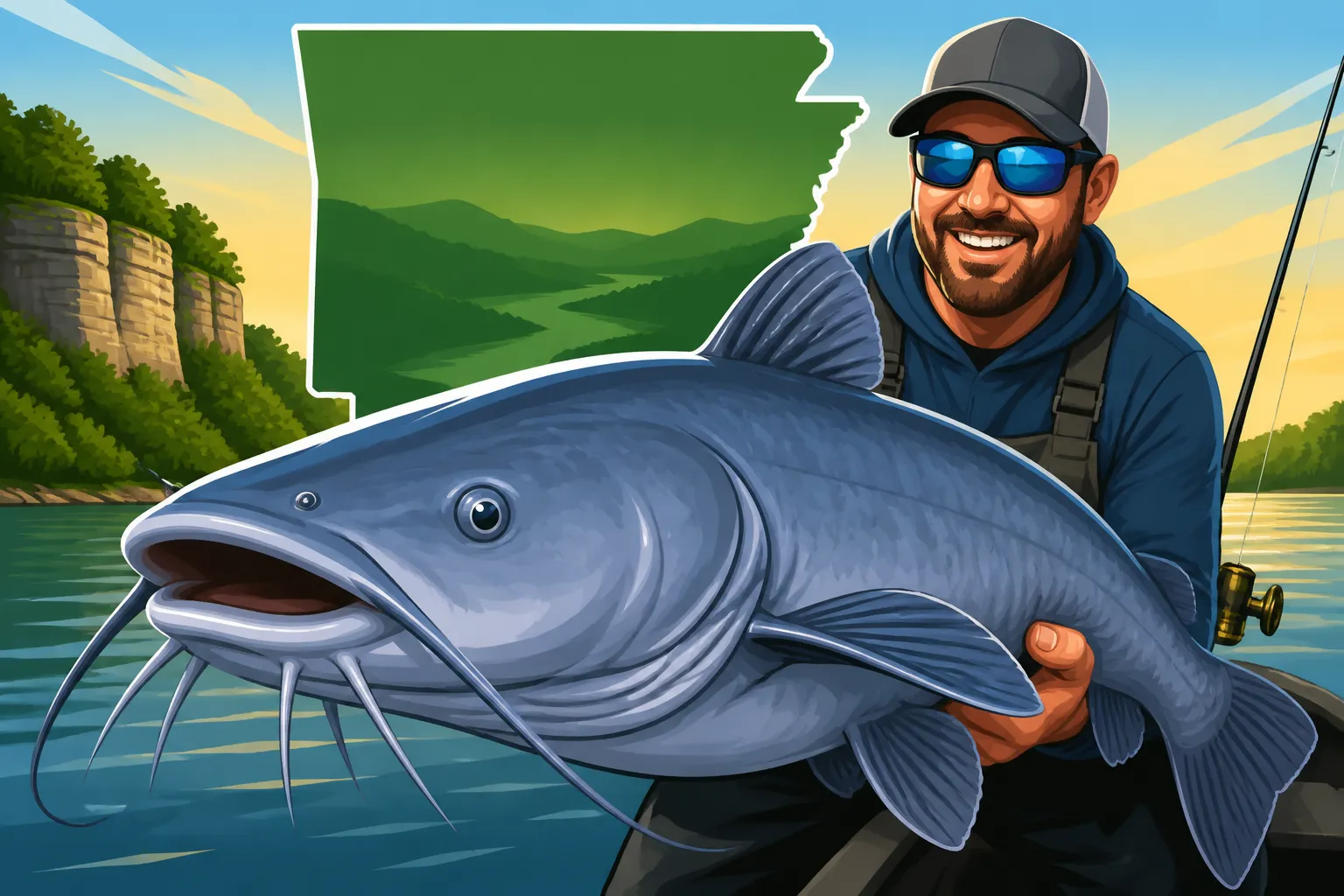
Blue cats typically have a deeply forked tail, a relatively straight anal fin with 30-36 rays, and a noticeable hump on their back when they grow larger. Their body is generally sleek and silver-blue to slate gray. Channel catfish, while also having a forked tail, usually have scattered black spots on their sides (though these can fade in older, larger fish), and their anal fin is more rounded with fewer rays (24-29). Flathead catfish (Pylodictis olivaris) are distinct with their flattened, broad head, mottled brown or yellowish coloration, and a square or slightly rounded tail, never deeply forked. Knowing these features is vital not just for identification, but also for respecting specific species regulations. For a deeper dive into telling the difference, check out How to Tell Channel, Blue, and Flathead Catfish Apart.
Where to Find Trophy Blue Catfish in Arkansas: Hotspots for Giants
Arkansas is blessed with incredible waterways, many of which hold world-class blue catfish. If you're serious about hooking into a monster, you need to know where these giants call home. These aren't just good fishing spots; these are proven battlegrounds for trophy-sized fish.
Arkansas River: A Blue Catfish Powerhouse
When it comes to trophy blue catfish in Arkansas, the Arkansas River stands as an undisputed champion. This mighty river system, with its series of locks and dams, creates an ideal environment for these large predators. The constant flow, the rich abundance of baitfish like shad and skipjack, and the deep, scour holes around the dams and channel bends provide everything a blue cat needs to grow to epic proportions. Anglers consistently pull fish weighing over 50 pounds from these waters, and triple-digit fish are not out of the question.
Focus your efforts around the navigation locks and dams, such as those near Little Rock, Pine Bluff, or Fort Smith. The turbulent water below the dams creates oxygen-rich feeding zones, and the deep eddies and current breaks offer prime ambush points. Look for submerged structure, major river bends, and deep channels where baitfish congregate. The sheer volume of water and diverse habitat within the Arkansas River system makes it a top-tier destination for any trophy blue catfish angler. It's truly a bucket-list fishery for those chasing giants, offering a real challenge and immense rewards. You can learn more about fishing this area in Arkansas River Fishing for Bass and Catfish.
Mississippi River: Uncharted Big Cat Territory
While perhaps less talked about than the Arkansas River for blue cats by some, the Mississippi River, particularly along Arkansas's eastern border, is an absolute beast of a fishery that holds truly colossal blue catfish. This massive, wild river offers an almost unlimited supply of food and habitat. The sheer scale of the Mississippi can be daunting, but for those willing to learn its nuances, the rewards can be astounding. The current is strong, the snags are plentiful, and the fish are often enormous.
Areas around major confluences, like where the Arkansas River meets the Mississippi, are particularly productive. Look for deep holes, dike fields, wing dams, and submerged timber. Navigation channels, eddy lines, and current seams are also prime locations where baitfish get pushed around, attracting hungry blue cats. Fishing the Mississippi requires heavy tackle and a deep understanding of river currents and safety, but it's where some of the largest blue catfish in the country reside, often seeing less angling pressure than other well-known spots. Be prepared for a real wilderness experience and the possibility of a fish of a lifetime.
Other Notable Waters: Lakes and Reservoirs
Beyond the major rivers, Arkansas has several large reservoirs that also produce impressive blue catfish, though perhaps not with the same consistency for triple-digit fish as the big rivers. However, lakes can offer excellent opportunities for strong, healthy blue cats, often in the 20-50 pound range, with bigger ones possible.
- Lake Dardanelle: Part of the Arkansas River system, this reservoir near Russellville is known for its incredible bass fishing, but it also holds a healthy population of blue catfish that can reach significant sizes. The lake features extensive timber, deep channels, and plenty of current, especially near the dam.
- Lake Ouachita: While perhaps more famous for its crystal-clear water and diverse fishery, Lake Ouachita, one of Arkansas’s largest lakes, also has a solid population of blue catfish. Focus on the deeper creek channels and points.
- Millwood Lake: In southwest Arkansas, Millwood Lake is a flooded timber wonderland known for its excellent fishing, including big catfish. The dense cover provides ample habitat and ambush points for blue cats.
- Bull Shoals Lake: This massive Ozark reservoir, shared with Missouri, offers very deep, clear water. While not typically thought of as a trophy blue cat lake compared to the rivers, it does hold respectable blue catfish populations, especially in its lower, riverine sections and deep coves.
These lakes can sometimes be easier to navigate for anglers less accustomed to strong river currents, but the principles of finding deep water, structure, and baitfish still apply. For more general insights on where to cast your line, you can always refer to Best Catfish Spots in Arkansas.
Essential Gear for Trophy Blue Catfish: Building Your Arsenal
Catching a truly massive blue catfish isn't a task for flimsy equipment. These fish are powerful, relentless fighters, and they'll exploit any weakness in your tackle. Investing in the right gear isn't just about landing more fish; it's about handling these giants safely and efficiently.
Heavy-Duty Rods and Reels: Building Your Arsenal
For trophy blue catfish, your rod and reel setup needs to be robust, reliable, and capable of withstanding immense pressure. Think of it as an investment in your success and in the well-being of the fish.
- Rods: You'll want heavy to extra-heavy power rods, typically 7 to 10 feet long. Longer rods give you better casting distance, leverage for fighting big fish, and the ability to steer them away from snags. Look for rods with a fast to moderate-fast action, providing enough backbone to set a big hook into a cat's tough mouth while still having some flex to absorb powerful runs. Brands like Ugly Stik or Rippin Lips offer excellent, durable options that can be found easily on platforms like Amazon. Many trophy cat anglers opt for specialized catfishing rods that are designed specifically for this kind of abuse.
- Reels: A high-quality conventional (baitcasting) reel is generally preferred over spinning reels for trophy blue cats. Conventional reels offer superior cranking power, line capacity, and drag systems necessary for these fights. Look for reels with a strong, smooth drag, a robust gear ratio, and the capacity to hold at least 200-300 yards of heavy line. Reputable models from brands like Penn, Abu Garcia, or Daiwa are often recommended. A smooth drag is paramount; a jerky drag can snap your line or pull the hook. Remember, you're not just casting; you're often dropping heavy weights and battling fish that can peel line off like a freight train.
Line and Leaders: Strength and Abrasion Resistance
Your line is the crucial link between you and that potential state record. Don't skimp here.
- Main Line: Monofilament line in the 30-50 pound test range is a popular choice due to its stretch, which can act as a shock absorber during violent head shakes. However, many trophy hunters swear by braided line, typically 60-100 pound test. Braid offers superior strength-to-diameter ratio, zero stretch for incredible sensitivity, and excellent abrasion resistance. The lack of stretch means a more direct hookset, which is crucial when fishing deep or in current. Whichever you choose, ensure it's fresh and free of nicks.
- Leaders: Regardless of your main line, always use a heavy monofilament or fluorocarbon leader. This leader serves two purposes: providing an extra layer of abrasion resistance against rocks, timber, and the catfish's rough mouth, and acting as a stealthy connection to your hook. Leader material should be heavier than your main line, often 80-150 pound test, and can be anywhere from 18 inches to several feet long, depending on conditions and technique. A strong, reliable knot like the Palomar or Snell knot is essential for connecting your hook to the leader.
Terminal Tackle: Hooks, Weights, and Swivels
The small components of your tackle might seem insignificant, but they are critical for holding a giant blue cat.
- Hooks: Forget the small stuff. You need heavy-duty, ultra-sharp hooks that can penetrate a tough jawbone and hold up under extreme pressure. Circle hooks are overwhelmingly favored by trophy cat anglers for several reasons: they are incredibly effective at hooking fish in the corner of the mouth, minimizing deep hooking and making catch-and-release much safer for the fish. Sizes typically range from 8/0 to 12/0, depending on your bait size. Brands like Gamakatsu, Owner, or Mustad offer excellent circle hooks. Some anglers prefer J-hooks in similar sizes for certain applications, but if you're practicing catch-and-release, stick to circles.
- Weights: When fishing in strong currents, you'll need substantial weight to hold your bait in place. Sinker weights can range from 3 ounces to over 10 ounces, sometimes even more on the Mississippi. Common types include no-roll sinkers, pyramid sinkers, or heavy bank sinkers. The key is to use enough weight to keep your bait stationary or drifting slowly at the bottom, without being swept away. Make sure your weight is either rigged on a sliding sinker rig (Carolina rig style) or a three-way swivel rig to allow the fish to take the bait without immediately feeling the resistance of the weight.
- Swivels: Heavy-duty swivels are essential for preventing line twist and for connecting your main line to your leader, or for creating a three-way rig. Ball-bearing swivels are best for reducing twist, and they should be rated for at least twice your main line's breaking strength. Quality swivels, often found in bulk on Amazon, will ensure your setup doesn't fail under pressure.
Techniques for Landing a Giant: Strategies for Success
Catching a trophy blue catfish isn’t usually about casting a worm under a bobber. It demands specialized techniques, patience, and often a bit of grit. Here are some proven strategies for targeting those giants.
Drift Fishing: Covering Water for Cruisers
Drift fishing is an incredibly effective technique, especially on large rivers or open lake flats, where blue catfish are actively moving and foraging. Instead of waiting for the fish to come to you, you let the current or wind slowly move your boat and baits across prime territory. This allows you to cover a vast amount of water, presenting your bait to more fish.
To execute a successful drift, you'll need a good understanding of the current and your boat control. Typically, you'll deploy several rods, each with a heavy bottom rig (like a Carolina rig or a three-way swivel rig) baited with fresh cut bait. Use just enough weight to keep your bait tumbling along the bottom, but not dragging excessively. Some anglers use drift socks or a trolling motor on a low setting to control their speed. Pay close attention to your rod tips; blue cat bites can range from a subtle tap to a rod-bending thud. When a fish hits, let it take the bait for a few seconds before setting the hook firmly. Drifting over known blue cat haunts like deep channels, humps, and points where baitfish are abundant can be extremely productive. It's a proactive approach that puts your bait in front of more potential monsters.
Anchoring and Fan Casting: Waiting Them Out
Sometimes, the most effective approach is to anchor your boat in a strategic location and present multiple baits. This method is particularly effective when you've located a concentration of fish, or you're targeting a specific piece of structure known to hold big cats, such as a deep scour hole below a dam, a submerged hump, or a significant channel bend.
Once anchored, deploy several rods, fan-casting them in different directions to cover a wide area around your boat. Use heavy weights to ensure your baits stay on the bottom, even in strong currents. This allows you to present different types or sizes of bait simultaneously, or to fish varying depths on a sloped bottom. Patience is key here. Blue cats might take their time to investigate the scent trail of your bait. Ensure your rod holders are sturdy – a bite from a truly trophy blue cat can rip an unsecured rod into the water! This technique works wonders at prime river spots where the fish often stack up. For specific methods that often involve anchoring, consider Catfish Bottom Fishing Techniques.
Alternative Methods: Jugging and Trotlining
While rod and reel fishing offers a direct battle, jugging and trotlining are traditional methods for catching catfish that can be incredibly effective for larger numbers or for passively targeting trophy fish. However, these methods come with strict regulations in Arkansas, and it's absolutely crucial to familiarize yourself with them before deployment. Arkansas Fishing Regulations Guide will be your essential resource here.
- Jug Fishing: This involves fishing with individual lines attached to buoyant jugs or floats. Each jug acts as an independent fishing line. Baits are set at varying depths, and the jugs are allowed to drift freely (or sometimes anchored in place, depending on local rules). When a fish takes the bait, the jug will bob, move, or even take off across the water, indicating a strike. This can be an exciting way to catch multiple fish, and large blue cats are certainly not immune to a well-presented jug line. For beginners, understanding Jug Fishing Basics for Catfish is a great starting point.
- Trotlining: A trotline consists of a main line stretched between two anchor points (often across a river or along a bank), from which multiple baited hooks are suspended on shorter droppers. Trotlines can be very effective for covering a large area and consistently catching catfish. Again, the regulations around trotlining, including length, number of hooks, and identification requirements, are very specific and must be followed to the letter. Trotline Fishing Basics can provide more detail on setting these up responsibly and legally.
Both jugging and trotlining require specific licensing and adherence to local laws. Always consult the latest Arkansas Game and Fish Commission regulations to ensure you're compliant.
Seasonal Considerations for Blue Catfish: Timing is Everything
Blue catfish, like most fish, have predictable seasonal patterns that influence their location, activity levels, and feeding habits. Understanding these shifts is crucial for consistently finding and catching trophy specimens throughout the year.
Spring: Pre-Spawn Feasting
As winter's chill gives way to warmer temperatures, blue catfish begin to become incredibly active. Spring, particularly from late March through May, is a prime time for pre-spawn feeding. Water temperatures begin to rise, signaling to the fish that spawning season is approaching, and they need to bulk up.
During this period, blue cats will move from their deep wintering holes into shallower, current-influenced areas where baitfish are more abundant. Look for them on river flats, current breaks, and the edges of submerged cover. They will actively chase and ambush prey, making them highly susceptible to cut bait presented on the bottom. The fish are often fat, healthy, and aggressive as they prepare for the rigors of spawning. This window offers some of the best opportunities to catch large numbers of quality fish, and often the biggest ones of the year, before they scatter for the spawn.
Summer: Deep Water and Night Bites
Summer can be a challenging time for trophy blue catfish, but certainly not impossible. As water temperatures soar, especially in late summer, blue cats tend to retreat to deeper, cooler, and more oxygenated water. This often means finding them in the deepest channels of rivers or the thermocline in large reservoirs.
Their feeding activity can slow down significantly during the heat of the day. This is when night fishing truly shines. As the sun sets and temperatures drop, blue catfish will often move shallower to feed under the cover of darkness. Targeting them at night with strong cut bait in known feeding areas can be incredibly productive. Look for deep holes adjacent to shallower flats where they might move to forage. Fishing bridges, rock piles, and deep current seams under the stars can yield impressive results. Remember, safety first when night fishing, and bring plenty of light. For specific tips on fishing after dark, see Best Bait for Night Fishing Catfish.
Fall and Winter: The Best Big Fish Window
Many serious trophy blue catfish anglers consider late fall and winter to be the absolute prime time for catching the biggest fish of the year. As water temperatures drop into the 50s and even 40s, blue cats become highly concentrated in specific areas and enter a feeding frenzy that can last for months.
In rivers, they will stack up in massive schools in deep holes, major channel bends, and scour holes near dams, often seeking refuge from strong currents and cold temperatures. In reservoirs, they'll similarly aggregate in deep water structures, adjacent to schools of shad. During this period, the fish are incredibly hungry, trying to pack on calories to sustain themselves through the coldest months. Presenting large pieces of fresh cut bait directly into these congregations can lead to multiple hook-ups with colossal fish. While the weather might be cold, the fishing can be red-hot, offering the best chance at a true monster. This is when the Arkansas River and Mississippi River truly shine for giants.
Conservation and Responsible Angling: Protecting Our Giants
Catching a trophy blue catfish is an incredible achievement, but it comes with a responsibility to ensure these magnificent fish continue to thrive for future generations. Practicing ethical angling and understanding regulations are paramount.
Catch and Release Best Practices
Many trophy blue catfish anglers practice catch and release, especially with the largest fish. These older, larger fish are vital to the health of the fishery's genetics. If you intend to release a fish, follow these guidelines:
- Minimize Fight Time: Use appropriate heavy tackle to land the fish as quickly as possible, reducing stress and exhaustion.
- Handle With Care: Avoid dragging large fish onto rough surfaces. If possible, keep the fish in the water while unhooking. If you must bring it on board, use a large, wet mat or blanket. Support the fish horizontally, never vertically by the jaw or gills, which can cause internal damage.
- Quick Unhooking: Use long-nosed pliers or de-hooking tools to remove the hook promptly. If the fish is deeply hooked and removal would cause excessive damage, cut the line as close to the hook as possible. Circle hooks greatly reduce deep hooking.
- Revive Properly: If the fish seems stressed or lethargic, hold it gently in the water, facing into the current, until it regains its strength and can swim away under its own power. Do not release a fish until it shows clear signs of recovery.
- Photography: If taking photos, do so quickly and keep the fish wet. Limit its time out of the water to a bare minimum. A quick measurement is fine, but don't prolong the process for a lengthy photoshoot.
Arkansas Regulations and Limits
Arkansas has specific regulations concerning blue catfish, including size and daily limits, which can vary by water body. These regulations are in place to protect the fish populations and ensure sustainable fishing. It's not enough to just know where to fish; you must know the rules!
- License Requirements: First and foremost, you absolutely need a valid Arkansas Fishing License Rules and Costs to fish legally in the state. Always carry it with you.
- Creel and Size Limits: While this guide focuses on trophy fish you're likely to release, it's critical to know the daily limits and any minimum or slot length limits for blue catfish in the specific waters you're fishing. These rules can change, so always consult the latest Arkansas Game and Fish Commission (AGFC) regulations guide before each season or trip. For example, some waters might have different limits to protect certain size classes of fish.
- Gear Restrictions: As mentioned earlier with jugging and trotlines, there are often rules about the number of lines, hooks, and types of gear you can use. Failing to follow these rules can result in significant Arkansas Fishing License Penalties and Requirements.
- Boat and Waterway Rules: Beyond fishing, be aware of general boating safety regulations, especially on large rivers like the Mississippi, which can be treacherous. Always carry appropriate safety equipment.
Protecting the Resource for Future Generations
The pursuit of trophy blue catfish is a passion shared by many, and ensuring the health of this fishery is a collective responsibility. Beyond individual catch-and-release practices and adhering to regulations, consider getting involved in local conservation efforts or supporting organizations that work to protect and enhance Arkansas's aquatic resources.
Educating fellow anglers, properly disposing of trash, avoiding pollution, and reporting any illegal fishing activities all contribute to a healthier fishery. The ability to chase 100-pound blue catfish in Arkansas is a privilege, and it's up to us to make sure that privilege continues for generations to come.
Comparison of Popular Catfish Species in Arkansas
To help you distinguish between your potential catches and understand their trophy potential, here's a quick comparison of the three main catfish species in Arkansas:
| Feature | Blue Catfish (Ictalurus furcatus) | Channel Catfish (Ictalurus punctatus) | Flathead Catfish (Pylodictis olivaris) |
|---|---|---|---|
| Typical Size | Can exceed 100 lbs (Trophy potential) | Rarely over 30 lbs, usually < 15 lbs | Can exceed 80 lbs (Trophy potential) |
| Appearance | Blue/slate gray, deeply forked tail, straight anal fin (30-36 rays), hump on large fish | Gray/tan, often spotted (can fade), deeply forked tail, rounded anal fin (24-29 rays) | Mottled brown/yellow, broad flattened head, square/slightly rounded tail, protruding lower jaw |
| Preferred Diet | Primarily fish (shad, skipjack), mussels, crustaceans | Omnivorous (insects, small fish, plants, prepared baits) | Primarily live fish (bream, carp, suckers) |
| Habitat | Large rivers, deep channels, reservoirs with current | Wide variety of waters, ponds, small rivers, larger lakes | Rivers, deep holes, dense cover, logjams, slow currents |
| Trophy Bait | Cut bait (shad, skipjack, carp) | Prepared baits, worms, chicken liver | Live bait (perch, sunfish) |
Disclaimer
This article is for general informational purposes only and does not constitute professional advice. Laws, prices and regulations vary by location and change over time. Consult a qualified professional for guidance on your specific situation.