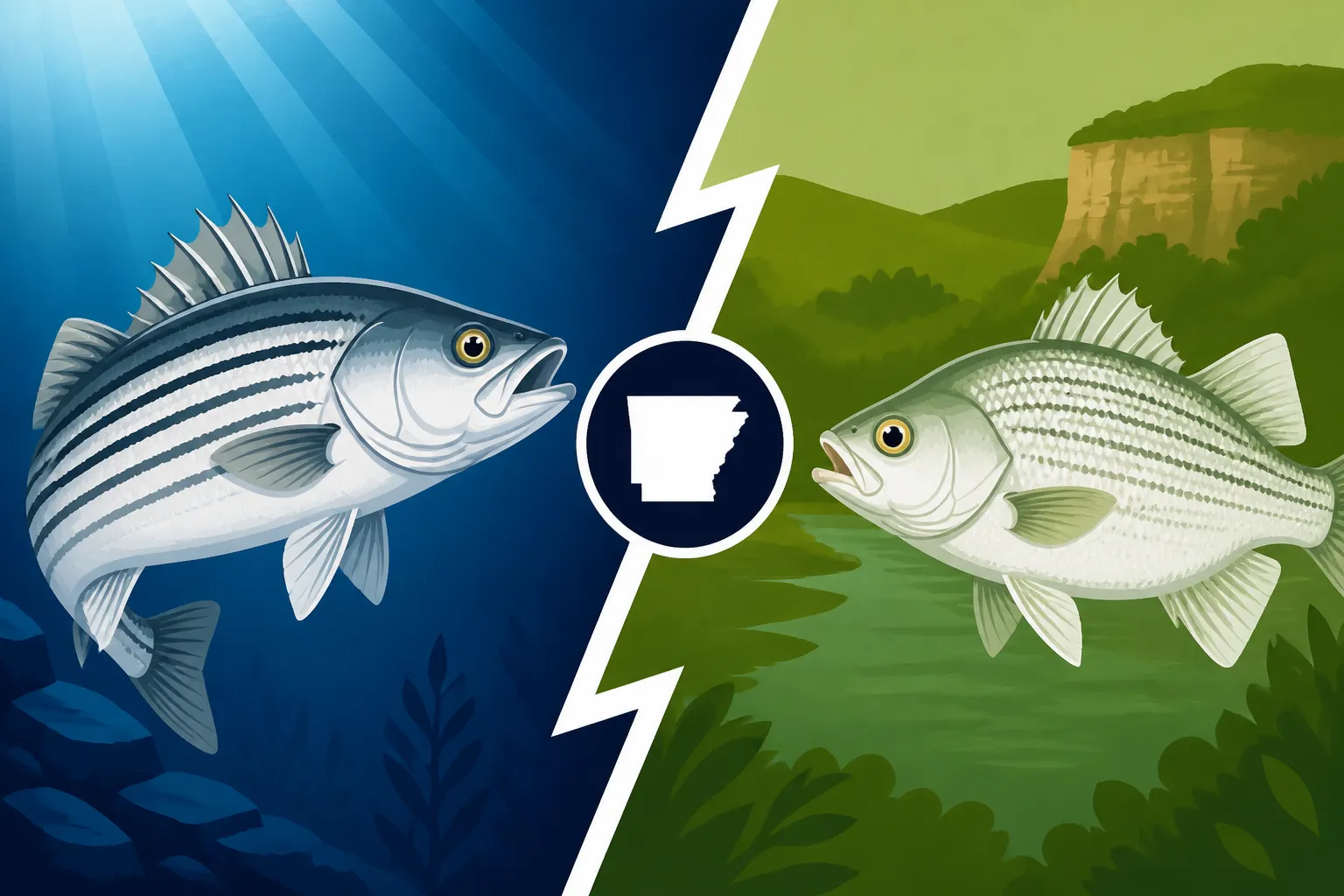
Striped Bass vs White Bass: How to Tell Them Apart
It's incredibly frustrating when you're out on the water, reeling in what you think might be a trophy, only to pause and wonder, "Is this a Striped Bass or a White Bass?" They can look so similar at first glance, especially if you're excited or not entirely familiar with all the nuances of Arkansas's diverse fisheries. Misidentifying your catch isn't just a minor inconvenience; it can lead to confusion about daily limits, or even cause you to release a fish you could have kept, or worse, keep a fish that's out of season or size for its species. This guide is here to cut through that confusion, giving you clear, actionable ways to tell the difference between these two fantastic fighting fish, ensuring you know exactly what you've landed every time.
The Common Mix-Up: Why Striped Bass and White Bass are So Often Confused
Anglers across Arkansas, from the seasoned veterans to those just dipping their toes into the sport, frequently find themselves scratching their heads when trying to distinguish between a Striped Bass and a White Bass. It's not just you; this is a genuinely common dilemma, and for good reason! Both species share habitats, chase similar prey, and, perhaps most misleadingly, sport those characteristic dark stripes that are their namesake. This superficial resemblance can make identification tricky, particularly when you're caught up in the thrill of a fight or the fish is splashing around in the net.
Shared Waters and Similar Habits
One of the primary reasons for the mix-up is that both Striped Bass and White Bass often inhabit the same large reservoirs and rivers across Arkansas. Think about a place like Norfork Lake or Lake Hamilton; you could easily be targeting stripers and hook into a white bass, or vice versa. They both thrive in open water environments, especially those with good baitfish populations like shad. This means they're frequently found in similar areas, often schooling together or in close proximity while foraging. For instance, if you're seeing a feeding frenzy on the surface, it could be either species, or even a mix, creating a quick burst of excitement and an immediate identification challenge. Understanding Norfork Lake: One of Arkansas's Best Striped Bass Fisheries helps you realize just how prevalent these fish are in shared environments.
Their feeding habits further blur the lines. Both are predatory fish, actively pursuing schools of baitfish. When you see boils on the surface or birds diving, it's a sure sign that a school of bass is pushing bait. In these chaotic, fast-paced moments, a quick glimpse of a silvery fish with stripes can easily lead to an initial misidentification. They both strike aggressively, and the fight can be similar, especially if you hook into a larger white bass or a smaller striper. This shared predatory nature means they're often caught on similar lures and baits, from lipless crankbaits to jigs, or even live shad, adding to the "surprise" element when you finally get the fish to the boat.
General Appearance at a Glance
The most obvious point of confusion, of course, comes down to their looks. Both fish are predominantly silvery in color, with darker backs, and prominently feature those tell-tale dark, horizontal stripes running down their flanks. It's like comparing two cars of the same model but different trim levels – they look alike enough to be confusing, but the details make all the difference. When you're standing on the bank or out on a boat, trying to make a quick ID, that initial impression of "striped silver fish" is what often leads anglers astray.
However, the devil is truly in the details when it comes to separating these two. While they both have stripes, the quality and arrangement of those stripes are critical differentiators. Furthermore, their overall body shape, mouth structure, and even a unique feature on their tongue are what ultimately give them away. Without knowing exactly what to look for, that quick glance will almost always leave you guessing, which is precisely what we aim to solve with the detailed breakdown in the following sections. Knowing what species you're catching is vital for adhering to Arkansas Fish Size and Daily Limits for different types of bass.
Distinguishing Features of Striped Bass
When it comes to the true "powerhouses" of Arkansas's open waters, the Striped Bass often comes to mind. These fish are built for speed and long-distance chases, and their physical characteristics reflect that. Once you know what to look for, a Striper becomes unmistakably different from its smaller cousin, the White Bass. These distinctions are not just academic; they're essential for correct identification, especially with varying regulations on different species. Many anglers head to the lakes hoping for the impressive fight of a Striper, and understanding their unique traits helps confirm your catch.
Body Shape and Size
The first and often most noticeable difference when you're holding one of these fish is its overall body shape and potential size. Striped Bass are, without a doubt, the behemoths in this comparison. They possess a long, sleek, and torpedo-shaped body, designed for powerful swimming in open water. Think of them as the finely tuned athletes of the aquatic world – streamlined and muscular, built for sustained speed and strength. Their bodies are more cylindrical and less compressed laterally compared to white bass.
While a "small" striper might still be a couple of pounds, they have an incredible growth potential. It's not uncommon for anglers to target Trophy Striped Bass Fishing in Arkansas where fish can reach 30, 40, or even 50 pounds in a lake like Norfork or Lake Hamilton. A truly impressive catch can feel like reeling in a small submarine! This sheer size difference often becomes the most obvious clue. If you're wrestling a fish that's pulling like a freight train and seems to go on forever, chances are good you've hooked a striper. For these larger fish, having robust gear, perhaps a heavy-duty rod and reel combo that you picked up from Amazon, is absolutely essential.
Stripe Characteristics
This is where the "striped" part of their name really comes into play, and it's a key visual identifier. Striped Bass typically have seven or eight prominent dark, horizontal stripes running along their sides. The critical detail here is that these stripes are almost always unbroken. They run continuously from just behind the gill plate all the way back to the base of the tail, without any interruptions or fading, especially above the lateral line. You'll often notice that several of these lower stripes extend all the way to the tail, giving the fish a very defined, clean striped appearance.
If you observe the stripes carefully, you might also notice that the lower stripes on a Striper tend to be quite distinct and well-defined, rather than faint or patchy. Imagine drawing a straight line with a ruler across its body – that's often how consistent these stripes appear. This unbroken pattern is a reliable visual cue, even from a slight distance, once you train your eye to look for it. It's one of the first things I check when I've got a bass in the net, as it immediately helps narrow down the possibilities.
Tooth Patch on Tongue
This is arguably the most definitive, foolproof way to tell a Striped Bass from a White Bass, and it's something every angler targeting these species should know. A Striped Bass has two distinct patches of teeth on its tongue. To check, simply open the fish's mouth gently and use your finger (carefully!) or the tip of a small tool to feel the top of its tongue. You'll feel two rough, distinct patches, almost like small sandpaper areas. They're usually separate and quite noticeable once you know what you're looking for.
This isn't a subjective visual cue like stripe consistency or body shape, which can sometimes be tricky depending on the fish's size or condition. The presence of two tooth patches is a biological characteristic that simply doesn't vary. If you find two patches, it's a Striper, end of story. This is the "gold standard" test when all other visual cues leave you second-guessing. It's an internal link that definitively points to the species.
Dorsal Fins
Another important anatomical feature to inspect on a Striped Bass is its dorsal fins. Like many bass species, they have two distinct dorsal fins. The first dorsal fin is spiny, meaning it's composed of hard, sharp rays. The second dorsal fin is soft-rayed, consisting of flexible rays. The key characteristic for Striped Bass is that these two dorsal fins are separate, with a noticeable gap between them. They do not connect or overlap at their bases.
This separation is fairly consistent across Striped Bass. While it might require a closer look than the stripes or the tongue patch, it provides yet another piece of evidence to confirm your identification. You can see this clearly if you gently spread the fins. This distinct separation is a reliable trait, rounding out the physical characteristics that set Striped Bass apart from White Bass and other similar species you might encounter in Arkansas waters.
Distinguishing Features of White Bass
While Striped Bass are the big game, White Bass are no slouch when it comes to putting up a spirited fight on lighter tackle, and they're incredibly popular among Arkansas anglers, especially for their schooling behavior and delicious table fare. They might be smaller, but they're abundant and offer fantastic action. However, their physical similarities to stripers can be deceiving. Let's dive into the specifics that will help you confidently identify a White Bass every time. Knowing these details is crucial for anyone fishing in Arkansas, particularly in waters where both species thrive, like Lake Hamilton.
Body Shape and Size
In contrast to the sleek, elongated body of a Striped Bass, the White Bass has a noticeably deeper and more compressed body. They are shorter and taller, almost more "panfish-like" in their overall profile, though certainly larger than a typical bluegill or crappie. Think of them as having a more oval or football shape, rather than the torpedo of a striper. This lateral compression means they appear flatter when viewed head-on or from the rear.
Size is another key indicator. While a White Bass can grow to a respectable size, often in the 1 to 3-pound range, with some reaching up to 5 or 6 pounds, they rarely, if ever, approach the double-digit weights common for Striped Bass. If you've got a bass that's putting up a good fight but doesn't feel like it's going to strip all the line off your reel, it's very likely a White Bass. They are a fantastic fighting fish on light to medium tackle, perfect for family fishing trips or targeting schools in the summer. When outfitting for these smaller, yet feisty, fish, a lighter spinning rod and reel, easily found on Amazon, works perfectly.
Stripe Characteristics
This is one of the most visible and reliable cues for telling a White Bass apart from a Striper. While White Bass also have horizontal stripes, they are typically broken or interrupted, especially below the lateral line. You'll often see that the lower stripes, rather than being continuous, are broken into shorter dashes or spots, particularly towards the rear of the fish. Additionally, White Bass usually have only one distinct stripe that extends all the way to the tail, if any, unlike the multiple continuous stripes of a Striper.
Sometimes, the stripes on a White Bass can appear fainter or less defined than those on a Striped Bass. The overall pattern might look more mottled or disorganized. Pay close attention to the stripes beneath the lateral line; if they're jagged, broken, or simply don't extend cleanly to the tail, you've almost certainly got a White Bass. This visual check is often the quickest way to make an initial assessment once you've trained your eye to spot the difference.
Tooth Patch on Tongue
Just like with Striped Bass, the tooth patch on the tongue is a definitive identifier for White Bass, and it's the exact opposite of what you'll find on a striper. A White Bass has only one single, relatively small tooth patch on its tongue. When you gently open its mouth and feel the tongue, you'll locate a single, rough patch in the center. There won't be two distinct, separate patches as you would find on a Striped Bass.
This is the ultimate tie-breaker. If the stripes are ambiguous, or the size isn't a clear indicator, this internal feature provides an undeniable answer. It's a quick, easy check that eliminates all doubt. Just remember to be careful and gentle when checking a fish's mouth. This crucial detail, along with the stripe pattern, forms the backbone of accurate identification for these two popular species.
Dorsal Fins
The dorsal fins of a White Bass are also important to observe. Like Striped Bass, they possess two dorsal fins: a spiny anterior fin and a soft-rayed posterior fin. However, the spacing and connection can be subtly different. While they are technically separate, the gap between the two dorsal fins on a White Bass is generally less pronounced than on a Striped Bass. Sometimes, they can appear almost connected at their bases, or at least much closer together, creating a less distinct separation.
While not as immediately obvious as the broken stripes or the single tongue patch, the dorsal fin arrangement provides another piece of the puzzle. When combined with the other indicators, it helps to build a clear picture of whether you're holding a White Bass or a Striped Bass. Paying attention to all these details will make you a much more confident and knowledgeable angler, better prepared to understand and abide by Arkansas Fishing License Regulations Guide.
Practical Identification Tips for Anglers
Let's be honest, when you've got a fish flopping around in the boat or on the bank, you don't always have time for a detailed biological examination. You need quick, reliable methods to tell what you've caught. The goal isn't just to satisfy curiosity, but to ensure you're following regulations and truly enjoying your time on the water. Confidence in identifying your catch enhances the entire fishing experience.
The "Tooth Test" is King
Seriously, if you learn only one thing from this guide, let it be this: the tooth patches on the tongue are the most reliable way to differentiate between a Striped Bass and a White Bass. All other visual cues—stripes, body shape, even size—can have minor variations due to age, water conditions, or individual fish differences. But the tooth patches are a consistent, biological fact.
Here's how to do it:
- Safety First: Handle the fish gently but firmly. If you're squeamish about putting your finger in a fish's mouth, use the blunt end of a small tool, like a pen cap or a fishing multi-tool.
- Open the Mouth: Gently but firmly open the fish's mouth.
- Locate the Tongue: Look and feel for the tongue.
- Count the Patches:
- Two distinct, rough patches? You've got a Striped Bass.
- One single, central rough patch? That's a White Bass.
This test is quick, and once you've done it a few times, it becomes second nature. It eliminates all guesswork and gives you a definitive answer every single time. It's truly the ultimate tool in your fish identification arsenal.
Quick Visual Cues
While the tooth test is definitive, you can often make a very strong educated guess from a distance or with a quick glance by focusing on these visual cues:
- Body Shape: Is the fish long, sleek, and torpedo-shaped (Striped Bass)? Or is it shorter, deeper, and more compressed, almost like a football (White Bass)? This is often the first thing you'll notice.
- Stripe Pattern: Are the stripes unbroken and continuous from gill to tail, especially above the lateral line (Striped Bass)? Or are they broken, dashed, or less defined, particularly below the lateral line, with only one or no stripes reaching the tail (White Bass)?
- Overall Size: If it's a massive fish, pushing into the double-digits in weight, it's almost certainly a Striped Bass. If it's a smaller, scrappy fighter, likely under 5 pounds, a White Bass is a strong contender. While not foolproof (small stripers exist), it’s a good general indicator.
These quick checks, combined with the context of where you're fishing – are you on Best Striper Lakes in Arkansas or a smaller lake known for panfish? – can help you narrow down the possibilities rapidly. Keeping a laminated fish identification card, perhaps one you ordered from Amazon, in your tackle box is a great idea for quick reference in the moment.
Gear Considerations and Targeting
The type of gear you're using can sometimes offer a hint about what you're likely to catch, though both species can certainly surprise you. Anglers specifically targeting Striped Bass Fishing in Arkansas often use heavier rods, reels spooled with stronger line, and larger baits or lures designed to handle the power of these bigger fish. They might be trolling large crankbaits, slow-rolling big swimbaits, or fishing with substantial live bait like gizzard shad.
Conversely, if you're using lighter spinning gear, smaller jigs, or crappie-sized baits, you're statistically more likely to encounter White Bass. They're often caught on smaller lures like Road Runners, Rooster Tails, or small spoons. While a small striper might occasionally hit a smaller lure, if your tackle is specifically geared towards panfish or smaller game fish, and you hook into a spirited fighter, it’s often a good bet it's a White Bass. Of course, the real fun is when a monster striper decides to inhale a tiny lure meant for something else entirely! Knowing the various Arkansas Fish Species: A Complete Guide to What's Swimming in Your Waters can also help you predict your catch.
Comparing Striped Bass vs. White Bass
Here's a quick reference table to help solidify the differences:
| Feature | Striped Bass | White Bass |
|---|---|---|
| Body Shape | Long, sleek, torpedo-shaped, more cylindrical | Deeper, more compressed, "football" shaped |
| Size | Much larger, often 10+ lbs, can be 40+ lbs | Smaller, typically 1-3 lbs, rarely over 6 lbs |
| Stripe Pattern | 7-8 prominent, unbroken stripes; several extend to tail | Stripes often broken or interrupted, especially below lateral line; usually only one to tail |
| Tongue Teeth | Two distinct patches of teeth on tongue | One single patch of teeth on tongue |
| Dorsal Fins | Two separate dorsal fins, noticeable gap | Two separate dorsal fins, gap less pronounced |
| Pectoral Fin | Pectoral fin does not reach the gill cover when pressed forward | Pectoral fin extends beyond the gill cover when pressed forward |
| Habitat | Large reservoirs, rivers, coastal areas | Large reservoirs, rivers, often in tributaries |
| Fight | Long, powerful runs, relentless | Energetic, strong short runs, spirited |
Understanding these differences will not only help you identify your catch with confidence but also better appreciate the unique characteristics of each species. Whether you're chasing trophy stripers or enjoying a fast-paced white bass bite, knowing your fish makes for a more informed and responsible angler in the beautiful waters of Arkansas.
Disclaimer
This article is for general informational purposes only and does not constitute professional advice. Laws, prices and regulations vary by location and change over time. Consult a qualified professional for guidance on your specific situation.