How to Find Striped Bass in Deep Water
There’s nothing quite like the rush of a big striped bass peeling line off your reel, but finding these elusive giants, especially when they’ve gone deep, can feel like searching for a needle in a watery haystack. Many anglers get frustrated trying to pinpoint stripers in the vast depths of Arkansas's big reservoirs. This comprehensive guide will equip you with the knowledge, techniques, and gear you need to consistently locate and catch striped bass in deep water, turning those challenging trips into triumphant ones.
Understanding Striped Bass Behavior in Deep Water
To successfully find striped bass in deep water, you first need to think like a striper. These powerful, open-water predators don't just go deep for the sake of it; there are very specific reasons that drive their vertical migrations. Understanding these motivations is the first step to unlocking their deep-water secrets.
Why Stripers Go Deep
Striped bass are highly sensitive to environmental factors, particularly water temperature, dissolved oxygen levels, and light penetration. As the seasons change, especially from late spring through summer and into fall, these factors dramatically influence where stripers choose to hang out.
During the warmer months, for instance, a phenomenon called "thermal stratification" occurs in most deep Arkansas lakes like Norfork or Bull Shoals. The water column divides into distinct layers: a warm, oxygen-rich upper layer (epilimnion), a rapidly changing middle layer (thermocline), and a cold, often oxygen-depleted bottom layer (hypolimnion). Stripers are cold-water fish, and they need a specific temperature range, typically in the 55-70 degree Fahrenheit range, to thrive. As surface waters heat up, they'll push down, seeking cooler comfort. However, they also need sufficient dissolved oxygen, which often concentrates in or just above the thermocline. This creates a sweet spot – often a narrow band of water – where stripers can find both cool temperatures and enough oxygen. You'll often find them congregating in or just above this thermocline, especially during the peak heat of summer. For more on this, check out our guide on Best Depth for Striped Bass During Summer.
Beyond temperature and oxygen, light penetration also plays a significant role. Stripers have large eyes and are efficient low-light hunters. Bright sunlight can drive them deeper into the water column, where light levels are reduced, making them feel more secure and giving them an advantage over their prey. This is why some of the best deep-water striper fishing often happens early in the morning, late in the evening, or on cloudy days when they might venture a bit shallower, but often still holding to deep structure.
Reading the Lake: Structure and Cover
Striped bass are active hunters, but they are also opportunistic, using underwater structure and cover as ambush points or resting areas. These features become even more critical in deep water, as they provide reference points in an otherwise featureless open-water environment. Knowing how to identify and interpret these structures is paramount.
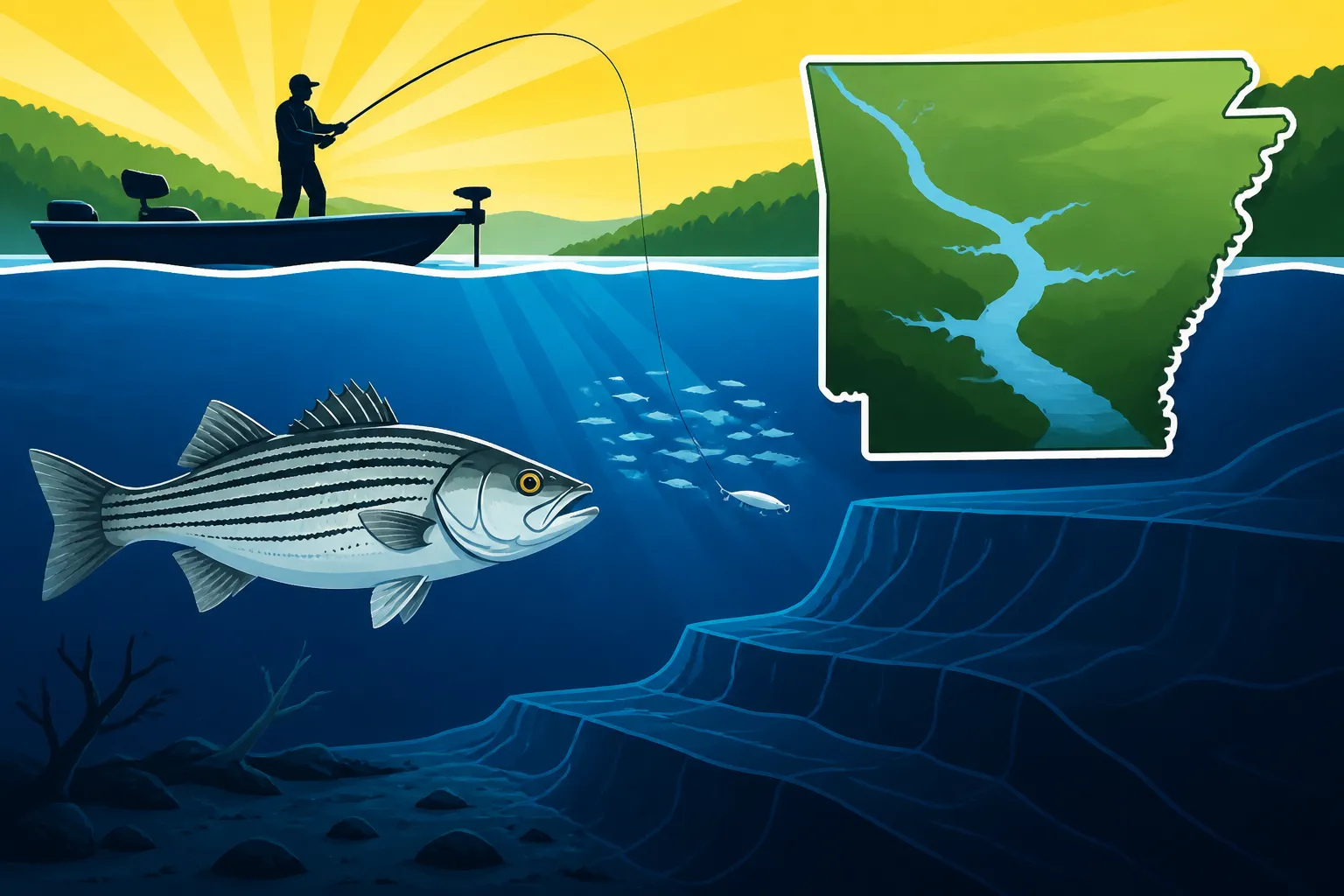
Look for underwater humps, which are essentially submerged hills or mounds. Stripers will often patrol the sides or tops of these humps, especially if baitfish are present. Ledges, which are sharp drop-offs or shelves, are another prime location. Stripers will cruise along these ledges, waiting for schools of shad to move by. Old creek channels, remnants of rivers that flowed before the lake was formed, act as underwater highways for baitfish and predators alike. Stripers will often follow these channels, particularly where they intersect with points or humps.
Standing timber, especially in lakes like Lake Ouachita or Norfork, provides excellent cover. These submerged forests offer shade and structure that attract baitfish, and in turn, stripers. While they might be intimidating to fish around, knowing how to approach them can be highly rewarding. Points, whether submerged or extending from the shoreline, are always key areas. Stripers will position themselves off these points, using them as staging areas to ambush passing schools of bait. The deeper the water off the point, the more likely you are to find stripers holding there when conditions drive them down.
Learning to read your electronics to identify these structures is an absolute game-changer. These aren't just random spots; they are critical pieces of the underwater puzzle that hold fish. Understanding why stripers are in these locations, whether it's for thermal comfort, oxygen, or ambush opportunity, will make you a much more effective angler.
Essential Gear and Electronics for Deepwater Stripers
Catching deep-water striped bass isn't just about knowing where they are; it's also about having the right tools to reach them and reel them in. These fish are powerful, and the depth adds another layer of challenge. Your gear needs to be up to the task, and your electronics are your eyes into the underwater world.
The Right Rods, Reels, and Line
When you’re talking about deep-water striped bass, you’re often talking about big fish and heavy demands on your tackle. You'll need equipment that can handle a strong fight and the pressure of working at depth.
For rods, think heavy action and a strong backbone. A medium-heavy to heavy power spinning or baitcasting rod, typically 7 to 8 feet long, is a good starting point. This length provides leverage for casting heavier baits and offers shock absorption when a striper makes a powerful run. The tip should be sensitive enough to detect subtle bites in deep water, but the bulk of the rod needs to be stout enough to put serious pressure on a fish.
Reels for deep-water stripers need to be robust with excellent drag systems. Whether you prefer spinning or baitcasting, choose models designed for saltwater or heavy freshwater use. They should have a high line capacity, as a big striper can easily strip off 100 yards of line in its initial run. Look for smooth, consistent drag that can be finely adjusted, preventing break-offs while still tiring out the fish. Some anglers might look for a specific model from a trusted manufacturer, and if you’re stocking up or upgrading, online retailers like Amazon offer a huge selection of options, allowing you to compare features and read reviews before making a purchase.
Line choice is critical. Braided line is often preferred for deep-water fishing due to its minimal stretch and high sensitivity. This allows you to feel those subtle bumps and bites from fish hundreds of feet below the surface. A 30-50 pound test braid is common. Because braid is highly visible, you'll want to add a fluorocarbon leader, typically 20-40 pound test and 4-8 feet long. Fluorocarbon is nearly invisible underwater and has excellent abrasion resistance, which is vital when fishing around structure or sharp-toothed stripers. This combination gives you the best of both worlds: sensitivity and strength with a stealthy presentation.
Sonar and GPS: Your Best Friends
You simply cannot effectively target deep-water striped bass without quality electronics. Sonar (fish finders) and GPS are not just helpful; they are absolutely essential for locating bait, stripers, and the underwater structure they relate to.
Modern fish finders offer an incredible array of technologies. 2D sonar gives you a traditional view of fish arches and bottom contours. Down Imaging (sometimes called DownScan or ClearVü) provides a photographic-like view directly beneath your boat, making it easier to distinguish structure from fish. Side Imaging (SideScan or SideVü) extends your vision out to the sides of your boat, allowing you to scan large areas quickly and spot schools of bait or stripers holding off to the side of a hump or channel. Many anglers swear by brands like Humminbird, Garmin, and Lowrance for their advanced features and reliability in deep-water applications. You can often find a wide range of models and accessories from these manufacturers through platforms like Amazon.
When using your sonar, don't just look for big red blobs on the screen. Learn to interpret what you’re seeing. Look for bait balls – dense clouds of small fish – because where there's bait, there are usually stripers nearby. Stripers often appear as distinct, elongated arches or marks, sometimes sitting directly beneath the bait ball or slightly off to the side, waiting to ambush. Pay attention to the depth at which you're seeing these marks; this is your target depth.
GPS is equally important. Once you find a promising school of fish, a productive hump, or a specific ledge that's holding fish, mark it as a waypoint on your GPS. This allows you to return to that exact spot, even if you drift away or need to make another pass. GPS also allows you to navigate creek channels, follow contour lines, and stay on track while trolling. Many modern units integrate sonar and GPS seamlessly, providing a powerful tool for deep-water exploration. Practice using these tools regularly; the more familiar you become, the more successful you'll be at finding deep-water stripers.
Proven Techniques for Targeting Deep-Water Stripers
Once you've located the fish and have the right gear, it's time to put your techniques to the test. Deep-water striped bass fishing requires different approaches than shallow-water tactics. These methods are designed to get your bait or lure down to where the fish are holding and entice them to strike.
Live Bait Presentation
When it comes to consistency, especially for larger stripers, it's tough to beat live bait. Striped bass are voracious predators, and a struggling live shad or herring is often irresistible. The key is presenting that bait naturally at the exact depth where the stripers are.
One of the most effective methods is down-lining. This involves rigging a live baitfish with a hook through the nose or back, and then attaching a heavy sinker (often 1-3 ounces or more, depending on depth and current) to the main line, several feet above the bait. The idea is to drop the bait straight down to the depth you've marked on your sonar, often right into a school of stripers. Use your electronics to guide you, lowering the bait just above or in the middle of the fish you see. A good tip for live bait presentation is to have a good aerated livewell to keep your bait lively, as a fresh, active bait is much more appealing. Our guide to Best Live Bait for Striped Bass can help you choose the right forage.
Free-lining can also work in deep water if there's sufficient current or wind to carry your bait naturally into a deep-water strike zone, though it's less precise for targeting exact depths. For vertical jigging or even slower trolling, some anglers will use balloon fishing with a heavy weight, allowing them to suspend live bait at a precise depth, though this is less common for very deep presentations compared to down-lining.
No matter the technique, pay close attention to your rod tip. Deep-water bites can sometimes be subtle, a slight twitch or a sudden bend. Stripers will often mouth the bait before committing, so patience is key. Give them a moment to take the bait before setting the hook.
Trolling for Deep Stripers
Trolling is an incredibly effective way to cover large areas of water and present lures at precise depths, making it ideal for finding scattered stripers or for when fish are actively moving. This method allows you to systematically work humps, ledges, and creek channels. You might even find some excellent tackle options for trolling, including specialized rods, reels, and a variety of lures, on Amazon.
Several techniques are employed for deep-water trolling:
- Downriggers: These devices use a heavy cannonball weight to carry your fishing line (which is attached to the cannonball with a release clip) to a predetermined depth. When a fish strikes, the line pops free from the clip, and you fight the fish directly. Downriggers offer the most precise depth control.
- Lead Core Line: This specialized line changes color every 10 yards, with each color representing a certain depth achieved at a given trolling speed. It's a low-tech way to get lures deep without heavy weights or specialized equipment, though it requires some trial and error to master.
- Planer Boards: While often associated with shallow-water trolling, larger planer boards can be used to spread out your lines and present baits over wider areas, sometimes in conjunction with lead core or deeper diving lures to target specific depths.
- Deep Diving Crankbaits & Umbrella Rigs: For depths down to 20-30 feet, large-lipped crankbaits can be trolled directly. For deeper water, heavy umbrella rigs, often laden with multiple bucktail jigs or swimbaits, can be incredibly effective. These mimic a school of baitfish and are incredibly enticing to stripers.
When trolling, experiment with your speed. Stripers will often react differently to varying retrieve rates. Typically, a speed of 2-4 mph is a good starting point, but let the fish tell you what they prefer. Keep an eye on your sonar for any signs of fish or bait, and adjust your depths and lures accordingly. If you're looking for more detailed strategies, our guide on Striped Bass Trolling Techniques can provide further insights. For a broader understanding of how these fish feed, consider reading up on Arkansas Striped Bass Fishing Techniques.
Vertical Jigging and Artificials
While live bait and trolling are staples, vertical jigging with artificial lures can be highly effective, especially when you’ve pinpointed a tight school of stripers on your electronics. This method is often more active and requires a good feel for your lure and the fish.
Popular artificials for deep-water stripers include:
- Heavy Spoons: Metal jigging spoons, ranging from 1 to 4 ounces or more, are fantastic for mimicking dying or wounded baitfish. Drop them straight down to the desired depth and then jig them with a sharp upward snap, letting them flutter back down on a semi-slack line. Most bites occur on the fall.
- Bucktail Jigs: These versatile lures, often tipped with a plastic trailer, can be fished in a similar vertical jigging fashion. Their pulsing action can be very appealing.
- Soft Plastics: Larger swimbaits or grub tails rigged on heavy jig heads can also be dropped down and retrieved with a slow, undulating motion or jigged vertically.
The key to successful vertical jigging is maintaining contact with your lure. This is where sensitive braided line really shines. Pay attention to any unusual slack in your line or a sudden weight; these are often bites. It might take a few drops to figure out the cadence the fish prefer, so experiment with your jigging motion, from aggressive snaps to more subtle lifts. You can find a huge variety of these artificial lures, from spoons to bucktails and soft plastics, readily available on Amazon, allowing you to quickly stock up for your next trip. This technique, when combined with accurate sonar readings, can be deadly for a school of stripers huddled on a deep point or channel.
Best Arkansas Lakes for Deep-Water Stripers
Arkansas is blessed with several fantastic lakes that offer prime opportunities for deep-water striped bass fishing. Knowing which lakes are best and what characteristics make them so special can help you plan your next striper adventure.
Norfork Lake: A Striper Haven
When it comes to trophy striped bass in Arkansas, Norfork Lake is often the first name that comes to mind. This sprawling reservoir, nestled in the Ozark Mountains, is renowned for its clear, deep waters and consistent populations of large stripers, many reaching truly impressive sizes.
Norfork's deep, cool waters are perfect for striped bass, providing the ideal thermal refuge they seek during the warmer months. The lake boasts an abundance of threadfin and gizzard shad, the primary forage for these powerful predators. The sheer size of the lake, with its numerous deep points, humps, and old river channels, creates endless opportunities for stripers to roam and ambush baitfish. Anglers often focus their efforts around the deeper parts of the lake, particularly near the dam and in the lower lake regions, where the thermocline provides that crucial comfort zone. Our detailed guide on Norfork Lake: One of Arkansas's Best Striped Bass Fisheries offers a deeper dive into what makes this lake so special. If you're chasing truly massive fish, then Norfork Lake's Reputation for Trophy Striped Bass Fishing is a must-read. During the summer, fishing at night or during low light conditions can also be productive, as stripers may move slightly shallower to feed before retreating to the depths.
Lake Hamilton and Bull Shoals Lake
While Norfork often steals the spotlight, other Arkansas lakes provide excellent deep-water striper fishing as well. Lake Hamilton and Bull Shoals Lake are two prime examples, each with its own unique characteristics that attract these powerful fish.
Lake Hamilton, located near Hot Springs, is known for its incredible striped bass fishery. While it might not always produce the sheer numbers of Norfork, Lake Hamilton consistently yields large, hard-fighting stripers. The lake's clear water and deep channels, especially near the dam and around major lake points, provide ample deep-water habitat. Like Norfork, Lake Hamilton experiences thermal stratification, driving stripers to the comfortable depths of the thermocline during summer. Anglers here often employ down-lining live shad or trolling deep-diving lures to connect with these fish. The recreational boat traffic can be heavy, but patient anglers who target less-frequented deep spots or fish during off-peak hours can find great success. To learn more about targeting these fish, our guide on Striper Fishing on Lake Hamilton in Hot Springs, Arkansas is a valuable resource.
Bull Shoals Lake, another massive Ozark reservoir, also offers significant deep-water striper opportunities. With its vast expanse of clear, deep water and extensive underwater structure, Bull Shoals holds a healthy population of striped bass. The lake's countless points, humps, and submerged timber provide ideal ambush points for stripers, especially when they move into deeper water. While Bull Shoals is perhaps more widely known for its excellent bass and crappie fishing, savvy anglers know that trophy stripers lurk in its depths. Trolling large umbrella rigs or down-lining live bait are common tactics here. Exploring the deep creek channels and major lake points, especially where they drop into significant depth, will increase your chances of finding these formidable fish. For a broader overview of this incredible fishery, consult our Bull Shoals Lake Fishing Guide for Bass and Crappie, which also touches on the striper potential.
| Technique | Primary Depth Range (feet) | Best Conditions | Key Gear | Pros | Cons |
|---|---|---|---|---|---|
| Down-lining Live Bait | 20-100+ | When stripers are schooled/suspended | Heavy rod, livewell, heavy sinkers | Highly effective, natural presentation | Requires live bait, can be slow to re-bait |
| Trolling (Downriggers) | 20-80 | Covering water, scattered fish, precise depth | Downriggers, trolling rods, large lures | Excellent for covering ground, very precise | Requires specialized equipment, can be complex to manage |
| Vertical Jigging | 30-150+ | Fish tightly schooled on structure | Sensitive rod, heavy spoons/jigs | Active, great for pinpointing schools | Requires good boat positioning and lure feel |
| Lead Core Trolling | 15-50 | Covering water, no downriggers | Lead core line, trolling rod, deep crankbaits | No specialized equipment, effective | Less precise depth control, heavy line |
Each of these lakes presents unique challenges and rewards, but with the right approach and a keen understanding of deep-water striper behavior, you can experience some truly unforgettable fishing in Arkansas. Whether you're targeting big stripers at Norfork or pursuing them in the depths of Hamilton or Bull Shoals, these strategies will help you put more fish in the boat.
Disclaimer
This article is for general informational purposes only and does not constitute professional advice. Laws, prices and regulations vary by location and change over time. Consult a qualified professional for guidance on your specific situation.