How to Tell a Kentucky Bass from a Largemouth at Bull Shoals
There’s nothing quite like the rush of a solid strike, the bend in your rod, and the thrilling fight to bring in a bass from the legendary waters of Bull Shoals Lake. But once you get that fish in the boat, a common challenge many anglers face is figuring out exactly which bass species you've landed, especially when it comes to the often-confused Kentucky bass and largemouth bass. This guide is here to cut through that confusion, helping you confidently tell the difference between these two fantastic game fish commonly found in Bull Shoals.
The Bass Family in Arkansas: A Quick Introduction
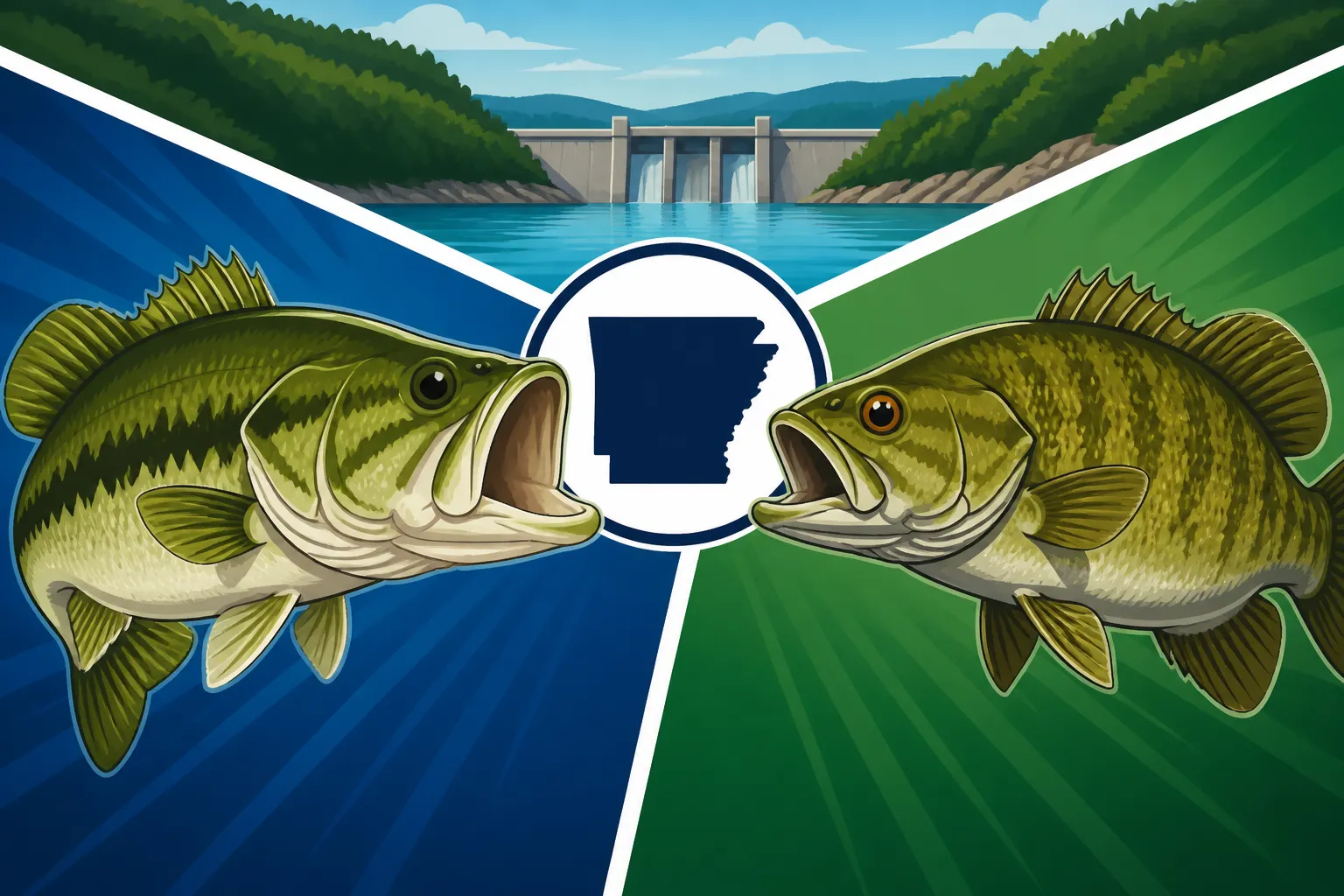
Arkansas is a haven for bass anglers, boasting a healthy population of several black bass species. When we talk about "bass," we're generally referring to members of the Micropterus genus, which includes the iconic largemouth, the feisty smallmouth, and the sometimes-puzzling Kentucky bass, also known as a spotted bass. While all three call parts of Arkansas home, it's often the largemouth and the Kentucky bass that cause the most head-scratching moments for anglers on impoundments like Bull Shoals Lake. Understanding their individual characteristics is the first step toward becoming a more knowledgeable and successful angler.
The Largemouth Bass Profile
The largemouth bass (Micropterus salmoides) is arguably the most recognizable freshwater game fish in North America, and it's certainly a favorite target for many fishing the numerous coves and timber-laden areas of Bull Shoals. They're often found in warmer, shallower water, preferring areas with plenty of cover like submerged trees, brush piles, lily pads, or thick grass. Their diet is quite varied, from baitfish and crawfish to frogs and even small birds or rodents, making them incredibly adaptable and a blast to catch on a wide array of lures.
When you think "bass," the largemouth is probably what pops into your head. They are famous for their aggressive strikes and powerful, acrobatic fights, often breaking the surface and shaking their heads violently to throw a hook. Knowing their preferred habitat and tendencies will give you a leg up when you're trying to target them specifically in the vastness of Bull Shoals. You can learn more about What Arkansas Lake Holds the Biggest Largemouth Bass?.
The Kentucky Bass (Spotted Bass) Profile
Then there's the Kentucky bass (Micropterus punctulatus), often called a spotted bass due to its distinct markings. These fish are perhaps a bit less famous than their largemouth cousins but are equally exciting to catch and have a growing fan base among Arkansas anglers. Kentucky bass typically prefer clearer, deeper water than largemouths, often congregating around rocky points, bluffs, humps, and current-swept areas. This makes them well-suited to the deep, rocky structure that defines much of Bull Shoals Lake.
Kentucky bass are known for their incredibly tenacious fight, often pulling hard and deep, trying to dive for cover rather than jumping. They're strong fighters pound for pound and can be incredibly rewarding to target, especially when other bass species are a bit shy. Their increasing numbers and willingness to bite year-round make them a fantastic quarry. Many anglers find themselves wondering What Is a Kentucky Bass? after catching one for the first time.
Key Distinguishing Features: How to Spot the Difference
When you've got a bass in hand at Bull Shoals, there are a few tell-tale physical characteristics that will help you definitively identify whether it's a largemouth or a Kentucky bass. These aren't subtle nuances; once you know what to look for, the differences become quite clear.
Jawline and Mouth Size
This is often the first and easiest identifier for many anglers. The name "largemouth" isn't just for show!
The largemouth bass has a jawline that extends significantly past the rear edge of its eye when its mouth is closed. Imagine a vertical line dropping down from the back of the eye; the largemouth's jaw will clearly cross it. This is a very reliable feature. Their mouth is indeed noticeably larger and wider, giving them that classic "bucketmouth" appearance. This large mouth allows them to engulf bigger prey, which is why they often hit larger baits with such ferocity.
In contrast, the Kentucky bass's jawline typically does not extend past the rear edge of its eye. Instead, it will end roughly under the middle or back of the eye. Their mouth is comparatively smaller and more proportionate to their head size. This difference might seem minor, but it's very consistent. If you're ever unsure, gently close the fish's mouth and trace an imaginary line down from the back of its eye to see where the jaw ends. This simple trick is often enough to make the call.
Dorsal Fin Separation
Another critical and highly reliable identifier lies in the dorsal fin, the fin on the fish's back. This is where the two species show a very distinct structural difference.
The largemouth bass has a deeply separated dorsal fin. It looks almost like two distinct fins connected by a very low membrane or even completely separated. There will be a noticeable dip or even a clear gap between the spiny front portion and the soft-rayed back portion of the fin. If you run your finger along the top of the fin, you'll feel a clear break. This separation is a hallmark of the largemouth.
The Kentucky bass, on the other hand, has a dorsal fin that appears connected. While there is still a spiny front and a soft-rayed back portion, the two parts are broadly joined, forming a single continuous fin. The dip between the two sections will be much less pronounced, almost forming a smooth curve rather than a deep cut. It won't look like two distinct fins. This connected dorsal fin is a consistent characteristic that quickly sets the Kentucky bass apart.
Lateral Line and Body Pattern
Beyond the mouth and dorsal fin, the body markings, particularly around the lateral line, offer crucial clues.
The largemouth bass typically has a prominent, dark, horizontal band running along its side, forming what's known as the lateral line. Below this lateral line, the scales are generally light-colored, without any distinct spots. Sometimes this lateral line can be broken or indistinct, especially in very dark or light-colored fish, but the absence of prominent spotting below it is key. Their overall pattern might be mottled or blotchy, but not usually with individual dark spots.
The Kentucky bass features a more pronounced lateral line, but below it, you'll see very distinct rows of small, dark, diamond-shaped or "spotted" scales. These spots form visible rows below the lateral line, giving the fish a speckled or spotted appearance, hence the common name "spotted bass." This pattern is much more consistent and is a definitive marker. If you see clear rows of spots below the lateral line, you're almost certainly looking at a Kentucky bass. This is an excellent feature to check, especially if the jawline or dorsal fin are unclear for some reason.
Tooth Patch on Tongue
This is perhaps the most definitive, yet sometimes overlooked, identifier for the Kentucky bass. It requires a gentle but thorough check of the fish's mouth.
The largemouth bass has a smooth tongue. If you gently open its mouth and look at its tongue, you'll find it entirely smooth to the touch, with no rough patches.
The Kentucky bass possesses a small, rough patch of teeth right in the center of its tongue. You can often feel this gritty patch with your finger (carefully, of course!) or see it as a slightly raised, darker area. This is a truly foolproof way to tell a Kentucky bass from a largemouth. If you're ever in doubt after checking the jawline and dorsal fin, this tooth patch is your final answer. For safety, many anglers use a pair of fishing pliers or a fish gripper to gently hold the mouth open and inspect the tongue. You might find a good set of identification tools or even a specialized fish gripper on Amazon that makes this easier.
To summarize these key differences, here's a handy table:
| Feature | Largemouth Bass | Kentucky Bass (Spotted Bass) |
|---|---|---|
| Jawline | Extends beyond the rear edge of the eye | Does not extend beyond the rear edge of the eye |
| Dorsal Fin | Deeply separated, appears as two distinct fins | Connected, forms a single continuous fin |
| Body Pattern | Pronounced lateral line, generally no spots below | Pronounced lateral line with distinct rows of spots below |
| Tongue | Smooth tongue | Rough patch of teeth on the tongue |
Habitat and Behavior Clues at Bull Shoals Lake
While physical features are the ultimate tell-all, understanding where and how these fish typically behave at Bull Shoals Lake can also give you strong hints even before you get them close enough to inspect. Their preferred environments and fighting styles are often quite different. For a deeper dive into the area, check out Bull Shoals Lake Fishing Guide for Bass and Crappie.
Where Largemouth Hide
At Bull Shoals, if you're fishing the backs of coves, around visible standing timber, submerged brush, or any available shallow cover, you're primarily in largemouth territory. They are ambush predators who love to conceal themselves and dart out to strike unsuspecting prey. Look for them in areas with softer bottoms, less current, and slightly warmer water temperatures.
Think about fishing the edges of creek channels that wind through shallow flats, or pitching jigs and plastics into thick cedar trees that have fallen into the lake. Largemouths will often be right up against this structure, waiting to pounce. They tend to be less active in the truly open, deep water that defines much of the main lake, preferring the sheltered, food-rich environments closer to shore or dense cover. You might find them suspended in timber if baitfish are present, but always close to that woody protection. When you're fishing for these guys, remember to target the densest cover you can find.
Where Kentucky Bass Roam
Kentucky bass, on the other hand, are structure-oriented but often prefer a different kind of structure than largemouths. At Bull Shoals, you'll find them holding tight to vertical bluff walls, steep drop-offs, rocky points, and submerged humps in deeper, clearer water. They are less dependent on dense overhead cover and more accustomed to using rock formations and depth changes to their advantage. They also tolerate current much better than largemouths, making them excellent targets in areas with some water flow.
If you're out on the main lake, casting to a rocky point that drops off into 40 feet of water, or slow-rolling a spinnerbait over a submerged saddle, you're likely in prime Kentucky bass habitat. They're often found in schools, especially around baitfish concentrations in open water. While they'll certainly venture shallower, their true domain is often the intermediate to deeper zones, making them a consistent catch when the largemouth bite slows down due to deeper water or bright conditions. They're often caught when targeting Smallmouth Bass Fishing on Bull Shoals Lake, as they share similar preferences.
Fight and Feeding Habits
The way a bass fights after being hooked can also offer a strong hint as to its identity. Both are powerful, but their tactics differ.
A largemouth bass is famous for its explosive, often acrobatic fight. When hooked, they'll typically make a powerful initial run, often jumping clear of the water and shaking their head violently in an attempt to dislodge the hook. They use their large, flat body to their advantage, turning sideways and pulling hard. Their strikes are often very aggressive, a hard thump or a sudden pull, especially when ambushing a bait from cover. They are often caught on topwater lures, spinnerbaits, and soft plastics pitched into heavy cover.
A Kentucky bass, however, tends to fight much "deeper." When hooked, they'll make strong, continuous runs, often trying to dive deep into cover or simply staying low in the water column. They are less likely to jump and more inclined to pull relentlessly, feeling heavier and stronger for their size compared to a largemouth. Their strikes can be varied, from a subtle tap to a solid thud, and they're particularly susceptible to finesse techniques, jigs, and crankbaits fished near rocky bottom structure. Knowing this difference can help you anticipate the fight and even adjust your gear.
Why It Matters: Regulations and Angling Strategies
Correctly identifying your catch isn't just about bragging rights or satisfying your curiosity; it has practical implications for both adhering to fishing regulations and refining your angling approach. The more you know about what you're catching, the better angler you'll become.
Bull Shoals Specific Regulations
While Arkansas has statewide fishing regulations, specific bodies of water, like Bull Shoals Lake, can sometimes have unique rules that apply only to them. These exceptions often pertain to size limits, daily creel limits, or even seasonal restrictions for particular species. If, for instance, there's a specific slot limit for largemouth bass on Bull Shoals that differs from the statewide rule, but Kentucky bass have a more general limit, knowing the difference is crucial. Releasing an illegally kept fish or missing out on keeping a legal one simply because of misidentification is a frustration no angler wants.
Always double-check the latest regulations from the Arkansas Game and Fish Commission before heading out. Sometimes, what looks like a small largemouth could actually be a legal-sized Kentucky bass, or vice-versa. Having a good field guide or keeping the official regulations accessible (perhaps even downloaded on your phone from Amazon for offline access) is a smart move. This ensures you're always fishing within the law and doing your part to conserve the fishery. For statewide rules, you might want to review Arkansas Fishing Regulations Guide.
Tailoring Your Approach
Beyond regulations, distinguishing between largemouth and Kentucky bass will significantly improve your fishing strategy. Knowing what species you're likely to encounter in a given spot, or identifying what you're primarily catching, allows you to adjust your lures, presentation, and even your boat positioning to be more effective.
If you're consistently catching Kentucky bass on a rocky point, you'll know to stick with baits that imitate crawfish or small baitfish, presented deeper and slower. You might switch to a football jig, a deep-diving crankbait, or a drop-shot rig. Conversely, if you're pulling largemouths out of submerged timber, you'll stick with weedless jigs, Texas-rigged worms, or spinnerbaits that can be worked through cover without snagging. The types of lures available on Amazon are vast, so knowing which species you're targeting helps narrow down your choices considerably.
By understanding their individual preferences and characteristics, you can make more informed decisions on the water. This means less wasted time on unproductive techniques and more time with a bent rod. It allows you to become a more versatile angler, able to adapt to different conditions and target specific species, ultimately leading to a more enjoyable and successful day out on Bull Shoals. Consider exploring Best Bait for Spotted Bass to fine-tune your approach for Kentuckys.
Disclaimer
This article is for general informational purposes only and does not constitute professional advice. Laws, prices and regulations vary by location and change over time. Consult a qualified professional for guidance on your specific situation.