Summer Striper Fishing at Norfork Lake Arkansas
Ah, summer fishing in Arkansas! While many of us are dreaming of lazy days on the lake, casting a line for bass in shallow coves, the dedicated striper angler knows that summer means a whole new game. The blistering heat and bright sun can make you think the fish have vanished, but the truth is, they've just moved to their cool, deep havens. If you're looking to tackle the exhilarating challenge of catching striped bass on Norfork Lake during these warmer months, you're in for a treat, but you'll need a solid game plan. This guide is all about navigating those deep, clear waters to find and hook those elusive summer stripers, ensuring your efforts lead to epic catches instead of just a sunburn.
Understanding Summer Stripers on Norfork Lake
Fishing for striped bass in Norfork Lake during the summer months is a completely different ballgame than in spring or fall. It's not just about tossing a lure and hoping for the best; it's about understanding the unique behavior of these powerful fish when the temperatures soar. Norfork Lake, known as one of Arkansas's best striped bass fisheries, presents its own set of challenges and rewards.
The Deep Dive: Why Stripers Go Low in Summer
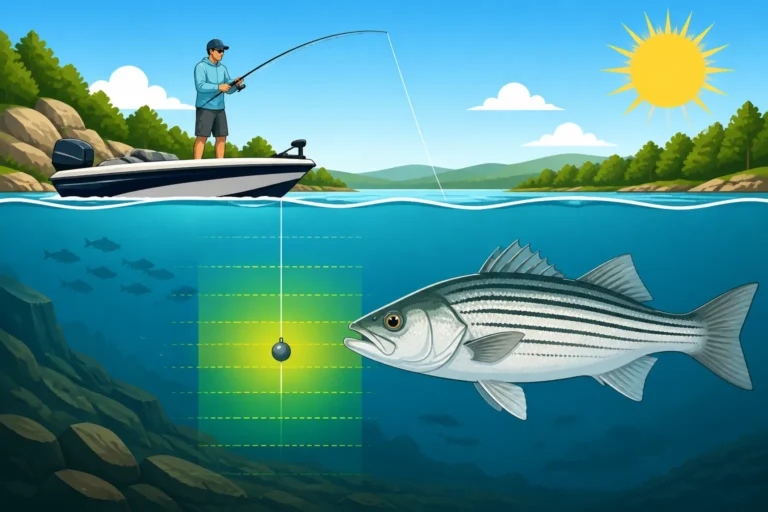
When the surface waters of Norfork Lake warm up, usually hitting the 80s or even 90s, striped bass don't just disappear – they seek refuge in cooler, oxygen-rich depths. This phenomenon is largely due to something called the thermocline. The thermocline is that distinct layer in the lake where the water temperature changes rapidly with depth. Above it, the water is warm; below it, it's significantly cooler. Stripers, being cold-blooded creatures, are constantly searching for their preferred temperature range, which typically falls between 60 and 70 degrees Fahrenheit.
Imagine yourself on a hot summer day. You wouldn't want to spend all your time in direct sunlight if there was a perfectly comfortable, air-conditioned room nearby, right? It's much the same for stripers. As Norfork Lake’s surface warms, they’ll dive down, often to depths of 30 to 60 feet, sometimes even deeper, to find that sweet spot. This means that your usual shallow-water tactics are going to be largely ineffective. You're no longer fishing the surface; you're essentially fishing the bottom of a cold-water river that exists within the lake. Understanding these movements is the first step to success. If you're new to the area, checking out our comprehensive guide on Norfork Lake: One of Arkansas's Best Striped Bass Fisheries can give you a great overview of this remarkable body of water.
Identifying Key Summer Habitats
Once you understand why stripers go deep, the next challenge is figuring out where in those depths they'll be. Norfork Lake's clear waters and abundant structure offer plenty of hiding spots. During summer, stripers are often found congregating around main lake channels, especially where these channels snake around humps, points, and deep timber lines. These submerged features act like underwater highways and ambush points for baitfish, which, of course, attract the stripers.
Picture a long, submerged ridge or a sharp drop-off that suddenly plunges into the main river channel. Baitfish like gizzard shad and threadfin shad will often school up along these structures, seeking their own comfortable depths and food sources. The stripers won't be far behind. They'll position themselves strategically to ambush these bait schools. This is where your boat's electronics become absolutely indispensable. You'll need to be scanning the water column constantly, looking not just for arcs representing stripers, but also for dense clouds of baitfish. Often, where you find the bait, you'll find the predators. Without good electronics, you're essentially fishing blind in a very large, deep swimming pool.
Essential Gear and Bait for Norfork's Summer Stripers
Summer striper fishing on Norfork Lake isn't for the faint of heart, or for the ill-equipped. To consistently hook into these strong, deep-dwelling fish, you need specialized gear that can handle the stress and get your bait to where the fish are.
Rods, Reels, and Line: Building Your Setup
When a big Norfork striper hits your line, you'll immediately understand why heavy-duty gear is a non-negotiable. These fish are absolute powerhouses, and they fight hard all the way to the boat. You'll want to arm yourself with stout conventional rods, typically 6 to 7.5 feet long, with a medium-heavy to heavy action. These rods need enough backbone to handle heavy weights, deep dives, and the sheer power of a surging striper.
Pair these rods with robust, high-capacity baitcasting or conventional reels. Look for reels with strong drags, capable of smoothly delivering 20-30 pounds of pressure, and a line capacity that can hold at least 300 yards of heavy line. Popular brands like Penn, Shimano, and Daiwa offer excellent options that have proven their mettle on big stripers. For line, braided line is the way to go, usually 50 to 80-pound test. Braid offers incredible strength, minimal stretch (which translates to better bite detection at deep depths), and a thinner diameter for its breaking strength, helping your baits sink faster. Just remember to tie on a 20-30 pound fluorocarbon or monofilament leader for abrasion resistance and invisibility. You can find a fantastic selection of these robust rods, reels, and lines on Amazon, often with reviews from fellow striper anglers that can guide your choices. Remember, replacing your line often is a good habit, especially when you’re pushing the limits on big fish.
Live Bait and Artificials: What They're Chasing
Stripers are opportunistic predators, and their diet in Norfork Lake primarily consists of smaller baitfish. In summer, getting the right bait down to their depth is paramount. Live bait is often king for summer stripers, especially when they're lethargic in the deeper, cooler water.
- Live Bait: Your primary targets for live bait will be gizzard shad, threadfin shad, and sometimes bluegill. Gizzard shad are particularly effective due to their size and oily nature. Catching and keeping live bait can be a project in itself – requiring cast nets, a large baitwell with aeration, and a good understanding of baitfish behavior. You'll want to keep your bait fresh and lively, as a struggling baitfish is less appealing to a deep-water striper. Using a high-quality live bait tank, easily found on Amazon, can make all the difference in keeping your bait healthy. For more specific insights, read our guide on the Best Live Bait for Striped Bass.
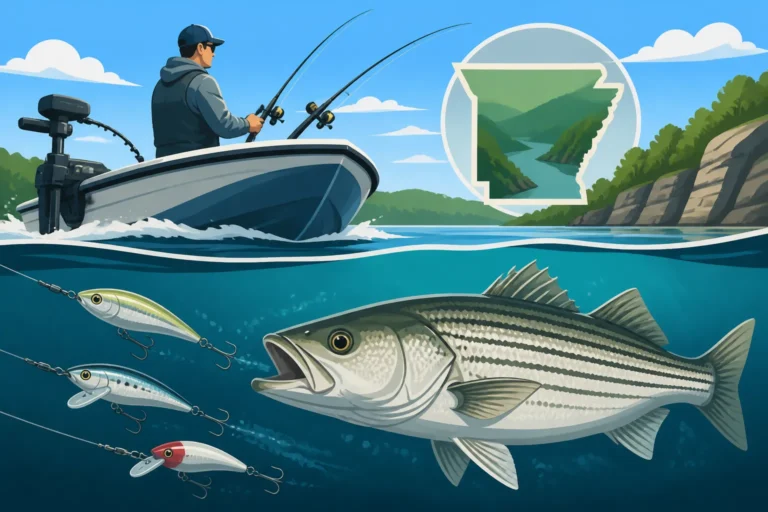
- Artificial Lures: While live bait is often preferred, artificial lures can also be highly effective, especially for trolling or when you find actively feeding schools. Deep-diving crankbaits from brands like Bandit, Rapala, or Norman are excellent for trolling, designed to reach significant depths. Large spoons, often 2-4 ounces, are fantastic for vertical jigging over marked fish. Bucktail jigs, especially in white or chartreuse, can also entice a strike when dropped directly into a school. It's often a good idea to have a variety of colors and sizes on hand, because what works one day might not the next.
The Role of Electronics and Downriggers
This is where summer striper fishing on Norfork Lake really diverges from other types of angling. Without reliable electronics and the right tools to get your bait to precise depths, you’re simply guessing.
- Fish Finders (Sonar): A high-quality fish finder is your absolute best friend when targeting deep summer stripers. Brands like Garmin, Humminbird, and Lowrance offer units with advanced CHIRP sonar, side imaging, and down imaging. You need to be able to clearly mark individual fish, identify schools of bait, and see the contours of the lake bottom, including humps, ledges, and submerged timber. Learning to interpret your sonar screen is a skill that takes practice, but it's crucial for locating those deep schools. Knowing How to Find Striped Bass in Deep Water is heavily reliant on mastering your electronics.
- Downriggers: These devices are game-changers for deep-water fishing. A downrigger uses a heavy lead ball (typically 8-12 pounds) attached to a cable, which you can lower to a specific depth. Your fishing line is then clipped to the downrigger cable with a release clip. This allows your bait or lure to be presented at a precise depth, often far deeper than a crankbait could dive on its own, and with less line out, which means a better fight. When a fish strikes, your line pops free from the clip, and you're fighting the fish directly, without the resistance of the downrigger ball. For Norfork Lake, having at least two downriggers will allow you to present multiple baits at varying depths, increasing your chances. You can find robust downriggers and all the necessary accessories, like release clips and extra weights, on Amazon.
- Outriggers or Planer Boards: While downriggers get your bait deep, outriggers or planer boards help spread your lines out horizontally from the boat. This is especially useful when trolling, preventing tangles and allowing you to cover a wider swath of water, mimicking a dispersed school of baitfish.
Effective Techniques for Summer Striper Success
Once you have your gear sorted, it's time to talk tactics. Summer striper fishing on Norfork Lake requires patience, precision, and a willingness to adapt. The fish are there, but they demand a specific presentation. For a broader perspective on the fishery, take a moment to review Striped Bass Fishing at Arkansas's Norfork Lake.
Trolling Deep: Covering Water
Trolling is arguably one of the most effective methods for summer stripers, especially when you're trying to locate scattered schools or cover a lot of water. This technique involves dragging lures or live bait behind your boat at a slow, consistent speed. The key, however, is getting your offerings to the precise depth where the stripers are holding.
This is where your downriggers become absolutely essential. You'll typically use them to present large spoons, deep-diving crankbaits, or even live bait at depths ranging from 30 to 60 feet, or whatever depth your fish finder indicates the stripers are. Experiment with different trolling speeds – usually between 2 and 3.5 miles per hour – until you find what triggers bites. Sometimes, a subtle S-turn with the boat can make your lure momentarily speed up or slow down, mimicking an injured baitfish and drawing a strike. Pay close attention to your fish finder during this process; if you start seeing fish at a certain depth, make sure your downriggers are dialed into that zone. You can learn more about general approaches in our guide to Striped Bass Trolling Techniques.
Live Bait Presentations: The Natural Approach
For many experienced striper anglers, live bait is the ultimate weapon, particularly when fish are less active or pinpointed on a specific piece of structure. The allure of a struggling live shad or bluegill is often irresistible to a hungry striper.
One common method is "free-lining" live bait, where you simply hook a lively shad through the nose or back and let it swim naturally. While this can work, in deeper water, you’ll need to add weight to get the bait down. A balloon rig can be effective: attach a balloon a few feet above your bait to keep it suspended at a desired depth, while a heavy sinker on your main line helps drag it down. Another popular technique is to simply use a weighted line. Attach a heavy egg sinker (2-6 ounces, depending on depth and current) a few feet above your hook. Drop this rig directly over marked schools of stripers, allowing the bait to swim enticingly in front of them. It's crucial to use appropriate hook sizes (like 5/0 to 8/0 circle hooks) that match your bait and ensure a solid hookset without harming the fish if you plan to release them.
Mastering the Vertical Jig
When your fish finder shows stripers stacked up tightly on structure, or schooled in a specific area, vertical jigging can be incredibly effective. This technique involves dropping a heavy spoon, bucktail jig, or even a specialized jigging lure directly down into the school and working it with sharp, upward retrieves followed by controlled drops.
The key to successful vertical jigging is precision and a quick reaction. Watch your sonar constantly. As your lure descends and approaches the fish, be ready for a strike. Often, the bite occurs on the fall. A common retrieve involves a sharp, 3-5 foot upward snap of the rod, followed by letting the lure flutter back down on a semi-slack line. Stripers will often hit as the lure flutters, so feeling that subtle "thunk" or seeing your line jump means it’s time for an immediate, strong hookset. This technique is physically demanding, but it can be incredibly rewarding when you hit a hot school. For those looking to learn more about reaching those elusive deep-water fish, consider exploring Deep Water Striper Fishing Techniques.
Timing Your Norfork Lake Striper Adventures
Even with the best gear and techniques, timing is still a critical factor in summer striper fishing success. Understanding when stripers are most active can make the difference between a frustrating day and a memorable one, especially since Norfork Lake’s reputation for Norfork Lake's Reputation for Trophy Striped Bass Fishing means you’re often aiming for those big ones.
Dawn and Dusk: Prime Feeding Windows
Just like many other predatory fish, stripers are most active during periods of low light. This makes dawn and dusk your prime windows for success during the summer. As the sun rises or sets, the light penetration into the water is reduced, making it harder for baitfish to see predators and giving the stripers an advantage. Furthermore, surface water temperatures tend to be cooler during these times, enticing stripers to move higher in the water column or closer to the edges of their preferred depth zones, making them potentially easier to access.
Imagine the quiet calm of Norfork Lake just as the sun peeks over the eastern bluffs, painting the sky with vibrant colors. This is often when the stripers are on the prowl, pushing baitfish to the surface or along deeper edges. Similarly, as the sun dips below the horizon, creating long shadows and a twilight glow, another feeding frenzy can ignite. Planning your trips around these low-light periods dramatically increases your chances of encountering actively feeding fish. While it’s technically about bass, the principles discussed in Best Time of Day to Catch Bass often apply to other predatory fish like stripers, emphasizing those magical twilight hours.
Weather's Impact on Striper Behavior
While we often think of summer as perpetually sunny, weather conditions can still play a significant role. Cloudy days, for instance, can extend the prime feeding window. The reduced sunlight penetration mimics dawn or dusk conditions, allowing stripers to remain more active throughout the day, rather than retreating to the deepest, darkest holes.
Conversely, sudden changes in weather, like a severe cold front pushing through, can make stripers lethargic and less willing to bite. Stable weather patterns, even hot ones, often mean more predictable fishing. Pay attention to wind and current, too. Wind can create currents that stack baitfish on certain points or ledges, which in turn will attract stripers. Norfork Lake also experiences generation from the dam, which can create current and move bait, triggering feeding activity. Knowing when the generators are running can provide a crucial advantage.
Navigating the Water Temperature Puzzle
We’ve already touched on how water temperature dictates where stripers reside in summer, but it bears repeating: finding the thermocline is like finding the striper's home address. Using a high-quality fish finder with a temperature gauge is essential. You're looking for that zone where oxygen levels are sufficient, and temperatures are in that comfortable 60-70°F range. This "sweet spot" can fluctuate based on daily conditions, so constant monitoring is key.
During a typical summer day, the thermocline might be at 30 feet in the morning and deepen to 40 feet as the day progresses. The thermocline also tends to be deeper in the main lake basins than in shallower coves. Understanding these subtle shifts and adjusting your downrigger depths accordingly will be critical. This constant "cat and mouse" game of finding the correct depth is what makes summer striper fishing so engaging and challenging. Many anglers find the Best Time of Year for Striped Bass Fishing at Norfork Lake often isn't the dog days of summer, but with these tips, you can extend your season effectively. If you're a visitor, remember to review the Nonresident Fishing License Rules for Arkansas to ensure you're compliant before heading out. And for all anglers, a quick check of the Arkansas Fishing License Rules and Costs is always a good idea!
To help you visualize some popular lure options for deep water summer striper fishing, here's a quick comparison:
| Lure Type | Typical Depth Range (with downrigger/weight) | Action/Presentation | Best Use | Target Speed (Trolling) | Key Features |
|---|---|---|---|---|---|
| Large Spoons | 30-70+ feet | Fluttering, flashy, mimics injured baitfish | Vertical jigging over schools, trolling on downriggers | 2.0-3.5 mph | High flash, heavy, good for reaction strikes, multiple colors |
| Deep Crankbaits | 20-50 feet (on their own), 30-70+ (downrigger) | Tight wiggle, strong vibration, large lip to dive deep | Trolling for actively searching fish | 2.5-4.0 mph | Realistic baitfish profile, various colors & patterns |
| Live Shad | 30-70+ feet | Natural swimming, erratic movements | Slow trolling or drifting over marked fish, suspended over structure | 0.5-1.5 mph (slow troll) | Most natural presentation, highly effective on finicky fish |
| Bucktail Jigs | 20-60+ feet | Pulsating hair, subtle profile, can be tipped with soft plastics or bait | Vertical jigging, casting to visible boils (rare in deep summer) | N/A (jigging) | Versatile, good in various colors, durable |
It's a lot to take in, I know! But the reward of landing a powerful Norfork Lake striper in the heart of summer is truly unmatched. Keep these tips in mind, stay persistent, and you'll be well on your way to some unforgettable fishing experiences.
Disclaimer
The information provided in this guide is for general informational purposes only. Fishing conditions, regulations, and fish behavior can change rapidly. Always consult the latest Arkansas Game and Fish Commission regulations before heading out, and prioritize safety on the water.