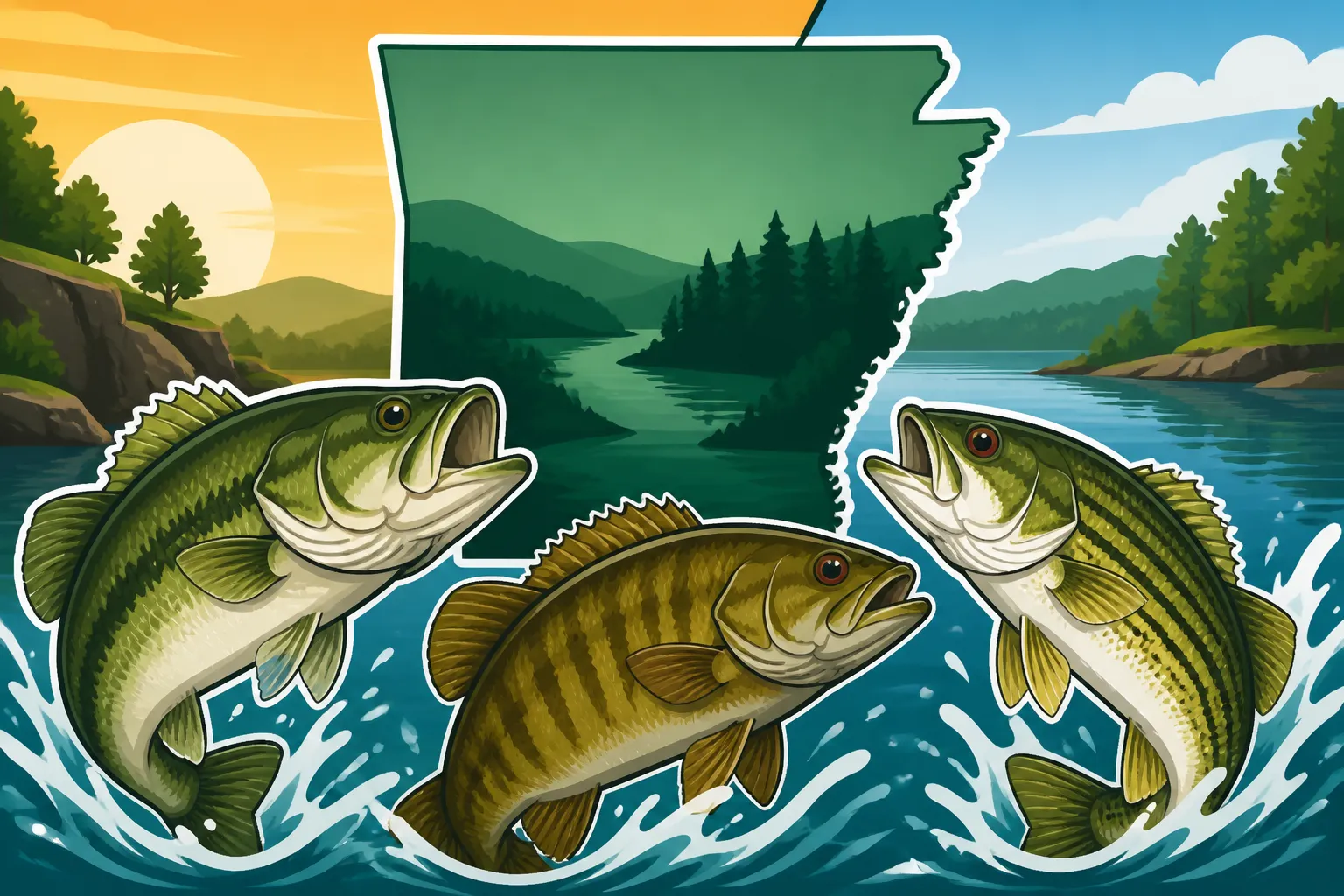
Bass Fishing in Arkansas: Largemouth, Smallmouth, and Kentucky Bass Explained
It's incredibly frustrating when you're out on the water, you hook into a fantastic bass, and then you're left scratching your head, wondering exactly what species you've just landed. Arkansas is home to three main types of bass that frequently confuse anglers: largemouth, smallmouth, and Kentucky (or spotted) bass. This comprehensive guide is here to clear up that confusion, helping you confidently identify each one, understand their preferred hangouts, and arm you with the best techniques to catch them across the Natural State.
Understanding Arkansas's Bass Fishing Landscape
Arkansas offers an incredible diversity of fishing experiences, from tranquil farm ponds to sprawling reservoirs and fast-flowing rivers. For many, bass fishing is the ultimate pursuit, offering thrilling fights and the challenge of outsmarting these cunning predators. But before you can truly master the art of bass fishing here, you've got to understand the cast of characters you'll be targeting. It's more than just a "bass" – each species has its own personality, literally affecting how and where you'll find them.
The Allure of Bass Fishing in the Natural State
There's a reason bass fishing holds such a special place in the hearts of Arkansas anglers. The state's waters are teeming with robust populations of these aggressive game fish, providing endless opportunities for both casual weekend warriors and seasoned tournament pros. Whether you're casting topwater lures at dawn on Lake Ouachita or carefully working a jig through the clear waters of an Ozark stream, the tug of a bass on your line is an exhilarating experience. The thrill of the chase, the strategic thinking required to present the perfect bait, and the sheer power of a strong bass fighting for its freedom are what draw so many to this sport. Plus, Arkansas boasts some truly breathtaking scenery to enjoy while you're out there.
Beyond the excitement of the catch, bass fishing in Arkansas connects you with the state's rich natural heritage. Our lakes, rivers, and streams are carefully managed to ensure healthy fish populations, creating a sustainable environment for future generations of anglers. It’s a chance to immerse yourself in nature, forget the daily grind, and create lasting memories, whether you're alone with your thoughts or sharing the experience with family and friends. The variety of waters available means there's always a new challenge, a new spot to explore, and a new strategy to refine.
Why Knowing Your Bass Species Matters
You might think, "A bass is a bass, right?" and while they all share some family traits, overlooking the distinctions between largemouth, smallmouth, and Kentucky bass is a huge disservice to your fishing success. Each species has unique preferences when it comes to habitat, forage, and even how they react to different baits. What works perfectly for a largemouth hiding in thick cover might completely spook a smallmouth in a rocky current, and vice-versa. Understanding these differences isn't just for bragging rights; it's fundamental to choosing the right fishing spot, selecting the most effective lure, and employing the most productive technique.
Think about it: if you're fishing a deep, clear reservoir with rocky points, but you're rigged for shallow-water largemouth with heavy weedless jigs, you're going to have a frustrating day. Conversely, trying to catch a smallmouth in a backwater slough choked with lily pads using a small crankbait designed for open water will likely yield nothing. Knowing your target species allows you to "match the hatch" of their environment and behavior, dramatically increasing your chances of a successful outing. It helps you decide if you need to be throwing a spinnerbait in the timber or a tube jig on the bottom of a swift river. This knowledge is the key to becoming a more adaptable and effective angler in Arkansas's diverse waters.
Largemouth Bass: The Arkansas Icon
The largemouth bass is undeniably the king of warm-water fishing in Arkansas, revered by anglers across the state. Its aggressive nature, impressive size potential, and tendency to inhabit easily accessible areas make it a perennial favorite. This is the bass most people picture when they think of "bass fishing," and for good reason – they're found in virtually every suitable body of water throughout Arkansas.
Identifying the Largemouth Bass
Distinguishing a largemouth bass from its cousins is usually the easiest task. The most obvious giveaway is right in its name: the large mouth. When its mouth is closed, the corner of its jaw extends beyond the back of its eye. This is the primary characteristic to look for. Beyond that, largemouths typically have a dark, prominent lateral line running horizontally along their sides, which often appears as a series of blotches or a jagged stripe, sometimes broken. Their coloration can vary quite a bit depending on their environment, ranging from a dark green or olive back that fades to lighter green or white on their belly, but that distinct lateral line is almost always there.
Their body shape also tends to be thicker and more football-like compared to the other bass species. They typically have two dorsal fins, but they appear almost completely separated, with a deep notch between the spiny front portion and the soft-rayed rear portion. The scales on their cheeks and gill covers are usually uniform in size. If you're holding a bass and that jaw extends past the eye, and it has a clear, often broken, dark stripe down its side, you've most likely got a largemouth. You'll often hear anglers refer to them as "bucketmouths" or "green trout" because of their distinctive appearance.
Preferred Habitats and Behavior
Largemouth bass are masters of ambush, preferring environments with plenty of cover where they can hide and surprise their prey. They thrive in warmer, often murkier waters, making them perfectly suited for many of Arkansas's lakes, ponds, and slower-moving rivers. Look for them around submerged vegetation like hydrilla, lily pads, and cattails. They also love to hang out in sunken timber, brush piles, rock piles, and alongside docks, bridge pilings, or any kind of structure that offers shade and a place to lurk. These fish aren't usually found in fast-moving currents; they prefer the calmer waters of coves, creek channels, and shallow flats.
Their behavior is largely dictated by water temperature and the availability of food. During the spring, you'll find them moving into shallow areas for the spawn, often around submerged bushes or old stumps. As summer heats up, they'll retreat to deeper, cooler waters or seek out dense overhead cover and shade during the day, becoming more active during dawn, dusk, or even at night. In the fall, they go on a feeding frenzy, bulking up for winter, and can be found actively chasing baitfish in shallower waters before moving to deeper structures once the cold sets in. Their diet is incredibly varied, consuming everything from baitfish, crawfish, and frogs to small birds and even rodents – they are truly opportunistic feeders.
Top Techniques and Baits for Largemouth
When it comes to catching largemouth bass in Arkansas, versatility is key, but some techniques are tried and true. Because they love cover, pitching and flipping jigs or Texas-rigged soft plastics into dense vegetation or submerged timber is incredibly effective. Baits like plastic worms, creature baits, and senkos rigged weedless are absolute staples. For a more aggressive approach, spinnerbaits and chatterbaits retrieved near cover can provoke powerful reaction strikes, especially in stained water.
Topwater lures like poppers, frogs, and walking baits are exhilarating to use, particularly during low-light conditions or when bass are actively feeding on the surface around lily pads or grass mats. Crankbaits, both shallow and deep-diving, are excellent for covering water and targeting different depths, especially when bass are relating to defined structure like points or humps. Don't forget the classic plastic worm, which can be fished in countless ways, from weightless wacky rigs to Carolina rigs, making it a go-to for many situations. Many anglers find a wide selection of these versatile baits easily available for purchase through online retailers like Amazon, making it simple to keep their tackle box fully stocked for any largemouth challenge. For tips on where to find them, you might check out articles like Best Bass Fishing Spots on Lake Ouachita, Arkansas or Best Bass Fishing Coves on DeGray Lake, Arkansas.
Smallmouth Bass: The Ozark River Fighter
Often called "brown bass" or "bronzebacks," the smallmouth bass is a powerhouse known for its incredible fighting spirit and aerial acrobatics once hooked. While not as widespread as the largemouth in Arkansas, smallmouths are highly sought after by anglers who appreciate a challenging fight in stunning, pristine river environments. They are predominantly found in the clear, rocky streams and cooler lakes of the Ozark and Ouachita Mountains.
Identifying the Smallmouth Bass
Unlike its largemouth cousin, the smallmouth bass has a distinctly smaller mouth. When its mouth is closed, the corner of its jaw does not extend beyond the back of its eye – it typically stops directly under the pupil. Their body color is generally a bronze or brownish hue, often with vertical bars or stripes that are more subtle and irregular than the single lateral line of a largemouth. These bars can sometimes resemble faint blotches or tiger stripes. Smallmouths also tend to have red eyes, which is another helpful distinguishing feature.
Their body shape is typically more streamlined and muscular, built for navigating currents. The two dorsal fins are connected, unlike the deeply notched separation on a largemouth. The scales on their cheeks and gill covers are noticeably smaller than those on the rest of their body, which is a subtle but consistent identifier. If you've caught a bass that's a beautiful bronzy color with vertical markings, a jaw that doesn't extend past its eye, and possibly red eyes, you've likely tangled with a tenacious smallmouth. They are true athletes of the water, and their appearance reflects their active, riverine lifestyle.
Preferred Habitats and Behavior
Smallmouth bass are creatures of clear, cool, flowing water, a stark contrast to the largemouth. You'll find them primarily in Arkansas's Ozark and Ouachita mountain streams and rivers, such as the Little Red, Buffalo, Crooked Creek, and portions of the White River system. They absolutely love rocky environments – think current seams, gravel bars, boulders, ledges, and deep pools with plenty of rocky substrate. They need good oxygen levels and prefer cooler water temperatures than largemouths, which is why they thrive in the mountainous regions.
These fish are incredibly territorial and will often hold in specific ambush points within the current, waiting for prey to drift by. They're primarily sight feeders, which is why clear water is so important to them. Their diet consists heavily of crawfish, hellgrammites, and various minnows. During the spawn, they'll create nests on gravel beds in shallower, protected areas of the river. In colder months, they may retreat to deeper pools or migrate downstream to larger bodies of water. Their aggressive strikes and powerful runs, often punctuated by acrobatic jumps, are legendary among anglers. Fishing for them often involves understanding current dynamics and where a smallmouth would logically position itself to feed. For more on specific rules, check out Smallmouth Bass Rules on Arkansas's Moving Waters Statewide.
Top Techniques and Baits for Smallmouth
Fishing for smallmouth bass is often a more finesse-oriented game, especially in clear water. Light line, small presentations, and stealth are crucial. Tube jigs are arguably the most iconic smallmouth lure, mimicking crawfish or baitfish as they're dragged or hopped along the bottom. Small crankbaits that imitate crawfish or minnows are also highly effective, especially when fished around rocky structure. Spinners and inline spinnerbaits, like Mepps or Panther Martins, are excellent for covering water in moving currents and triggering reaction strikes.
Soft plastic jerkbaits, grubs, and finesse worms rigged on a drop shot or shaky head can be deadly when smallmouth are finicky or holding in deeper water. Fly fishing with streamers that imitate baitfish or nymphs that mimic aquatic insects is also incredibly popular and productive on many smallmouth rivers. Because they are often found in relatively open, current-swept areas, precision casting and subtle lure presentations are often more important than brute force. When gearing up, don't forget to check Amazon for a great selection of these specialized smallmouth lures and terminal tackle that might be harder to find locally.
Kentucky Bass (Spotted Bass): The Underestimated Angler's Friend
The Kentucky bass, more commonly known as the spotted bass in Arkansas, often gets overshadowed by its largemouth and smallmouth relatives. However, these fish are incredibly fun to catch, possess a hard-fighting spirit, and are more widespread than many anglers realize, particularly in river systems and large reservoirs. They often occupy a niche between the largemouth and smallmouth, making them an intriguing target.
Identifying the Kentucky Bass (Spotted Bass)
Identifying a Kentucky bass often feels like solving a riddle, as it shares characteristics with both largemouth and smallmouth. The key identifiers are subtle but distinct. When its mouth is closed, the corner of its jaw usually extends to or just slightly beyond the back of its eye – falling somewhere between the largemouth (way past) and the smallmouth (not past). What really sets it apart is the presence of small, dark spots arranged in rows below its lateral line, creating a "spotted" appearance on its lower flanks. Its lateral line, while present, is often less pronounced or broken than a largemouth's.
Another critical ID feature is the patch of teeth on its tongue, which is absent in both largemouth and smallmouth bass. You can feel this by gently running your finger over the tongue. Its body shape is generally more streamlined than a largemouth but not quite as slender as a smallmouth. Like the smallmouth, its two dorsal fins are connected, though perhaps with a slightly deeper notch than the smallmouth. Its overall coloration is typically greenish-bronze. If you find a bass that looks like a blend of the other two, has spots below its lateral line, and a rough patch on its tongue, you've got yourself a Kentucky bass.
Preferred Habitats and Behavior
Kentucky bass are incredibly adaptable, often thriving in environments that are too clear or current-swept for largemouths, but not quite as cold or fast as preferred by smallmouths. You'll find them in many of Arkansas's larger river systems, like the Arkansas River, and in reservoirs that have a good mix of rock and timber, especially those with some current flow or deeper, clear water sections. They often inhabit creek channels, bluff walls, steep banks, and points where they can ambush baitfish. While they appreciate cover, they don't bury themselves in dense vegetation like largemouths. Instead, they prefer structure like submerged timber, rock piles, or artificial brush piles in deeper water.
Their behavior leans towards being schooling fish, particularly in deeper open water. If you catch one Kentucky bass, there's a good chance more are nearby. They are aggressive feeders, often pursuing baitfish in open water and making strong, bulldogging runs once hooked, typically staying deep rather than jumping. Their diet consists primarily of small baitfish, crawfish, and insects. They're active year-round and can be a reliable target even when other bass species are less cooperative, often holding tighter to structure in colder conditions.
Top Techniques and Baits for Kentucky Bass
Because Kentucky bass often school and prefer deeper, clearer water and rock/timber structure, techniques that cover water and target depths are often effective. Deep-diving crankbaits are fantastic for bumping off rocky bottoms and bluff walls. Jigs, especially football jigs or finesse jigs, are excellent for probing deeper structure where these bass congregate. Often, if you locate a school with your electronics, a jigging spoon or blade bait dropped vertically can trigger multiple bites.
Soft plastics, such as small worms, grubs, or swimbaits rigged on a jig head or a shaky head, are also very productive for a more subtle approach. They are less prone to being spooked than smallmouths and will often strike at more aggressive presentations than their size might suggest. If you're fishing a river system, targeting eddies, current breaks, and drop-offs with spinnerbaits or shallow crankbaits can yield great results. Many anglers swear by the effectiveness of a simple jerkbait when targeting schooling Kentucky bass on main lake points. Investing in a good selection of these versatile lures, perhaps from a trusted online retailer like Amazon, will certainly boost your chances of success.
Comparing the Three: Key Distinctions for Anglers
Now that we've looked at each bass individually, let's put them side-by-side to really highlight the critical differences. This comparison isn't just academic; it directly influences your choice of fishing location, tackle, and technique on any given day in Arkansas. Understanding these nuances is what separates a truly skilled angler from someone just hoping to get a bite.
Physical Traits and Identification
The easiest way to tell these three apart is to remember a few key physical characteristics.
- Largemouth Bass: The corner of its mouth extends beyond the back of its eye. It usually has a distinct, often broken, dark horizontal stripe down its side. The two dorsal fins are nearly separated by a deep notch. Its body is often stockier.
- Smallmouth Bass: The corner of its mouth does not extend past the back of its eye. It typically has subtle vertical bars or mottling on its sides, not a horizontal stripe. Its eyes often have a reddish tint. The dorsal fins are connected. Its body is more streamlined and muscular.
- Kentucky Bass (Spotted Bass): The corner of its mouth extends to or just slightly past the back of its eye (in between the other two). It has distinct small, dark spots below its lateral line. Crucially, it has a patch of teeth on its tongue. The dorsal fins are connected. Its body shape is generally similar to a smallmouth but a bit heavier in the belly.
Here's a quick reference table to help visualize these differences:
| Feature | Largemouth Bass | Smallmouth Bass | Kentucky (Spotted) Bass |
|---|---|---|---|
| Mouth Extension | Past the eye | Not past the eye | To or slightly past the eye |
| Lateral Markings | Prominent dark horizontal stripe/blotches | Subtle vertical bars/mottling | Scattered dark spots below lateral line |
| Dorsal Fins | Deeply notched, almost separated | Connected | Connected |
| Tongue | Smooth | Smooth | Rough patch of teeth |
| Eye Color | Standard | Often reddish | Standard |
| Body Shape | Stocky, football-like | Streamlined, muscular | Streamlined, but often slightly thicker than smallmouth |
Habitat Preferences and Fishing Strategies
The habitat each bass species prefers is a direct reflection of its predatory style and physiology. Largemouths are the kings of the shallow, warm, and often vegetative cover. If you're looking at a lake with lots of lily pads, submerged grass, or standing timber, you're in prime largemouth territory. Your strategy here should involve precision casting into tight cover, using weedless baits like jigs, soft plastics, or topwater frogs. They love to ambush.
Smallmouths, on the other hand, are adapted for clear, cool, flowing water with abundant rock and gravel. Think of the pristine Ozark streams. They prefer current breaks, rocky points, and ledges. Your tactics for smallmouth will lean towards finesse presentations – small tubes, crankbaits, or spinnerbaits worked along the bottom or through current seams. They are sight feeders, so clear water and natural presentations are key. Smallmouth Bass Fishing in Arkansas's Ozark Rivers details some fantastic spots.
Kentucky bass often bridge the gap, preferring deeper, clearer sections of reservoirs and river systems that might be too open for largemouth but not quite as wild as true smallmouth rivers. They love bluff walls, main lake points, and deep timber. Fishing for Kentuckys often involves covering water with deep crankbaits, spoons, or jigs, as they tend to school. If you find one, others are likely nearby, making vertical presentations effective. Understanding these habitat preferences means you can quickly narrow down your target species based on the body of water you're fishing.
Fight Characteristics and Eating Quality
Each bass species also offers a different experience once hooked, and their table fare can vary.
-
Largemouth Bass: Known for powerful, initial head shakes and spectacular jumps, especially when hooked near the surface. They tend to bulldog and dive into cover if given the chance. They are generally considered good eating, with flaky white meat, though some anglers find larger ones can have a slightly "muddy" taste depending on their habitat. Most are caught for sport, but they make a fine meal.
-
Smallmouth Bass: These are arguably the hardest fighting freshwater fish pound-for-pound. They make incredibly strong runs, deep dives, and frequent, acrobatic jumps. Their tenacity and refusal to give up make them a thrill to catch. Smallmouths are widely considered excellent eating, with firm, white, mild-flavored meat, often preferred over largemouths. Many anglers practice catch-and-release with smallmouths due to their sportfishing value and slower growth rates.
-
Kentucky Bass (Spotted Bass): They put up a very respectable fight, characterized by strong, deep dives and powerful, continuous pulls, often described as "bulldogging." They tend to stay deep rather than jumping as much as largemouths or smallmouths. They are also considered very good eating, often praised for their firm, white, and clean-tasting meat, similar to smallmouth. Because they are often abundant, many anglers keep a few for the dinner table.
Ultimately, the choice to keep or release any bass often comes down to personal preference, local regulations like Largemouth Bass Daily Limit in Arkansas, and the health of the fishery. But knowing what kind of fight to expect and what kind of meal you might prepare adds another layer to the Arkansas bass fishing experience.
Essential Gear and Tips for Arkansas Bass Anglers
Getting geared up for bass fishing in Arkansas can feel overwhelming with all the options out there. But remember, the goal is to match your equipment to the species you're targeting and the environment you'll be fishing in. A few core pieces of gear, combined with some general wisdom, will set you up for success.
Rods, Reels, and Line for Each Species
Selecting the right rod, reel, and line is foundational to effective bass fishing.
-
Largemouth Bass: For largemouths, especially when fishing heavy cover, you'll want a medium-heavy to heavy power casting rod (6'6" to 7'6" length) with a fast action. This provides the backbone to pull fish out of thick stuff and the sensitivity to feel subtle bites. Pair this with a baitcasting reel with a gear ratio that suits your technique – a faster ratio (7.1:1 or higher) for burning spinnerbaits, a slower one (6.4:1) for cranking. For line, 15-20 lb fluorocarbon offers low visibility and good abrasion resistance, or 30-50 lb braided line is excellent for heavy cover due to its strength and lack of stretch, often with a fluorocarbon leader. You can find robust options for all these categories on Amazon.
-
Smallmouth Bass: Smallmouth fishing often calls for lighter, more sensitive setups. A medium to medium-light power spinning rod (6'6" to 7' length) with a fast to extra-fast action is ideal for throwing lighter baits and feeling those subtle bites in clear water. A matching spinning reel in the 2000-3000 size range provides smooth retrieves and drag. Spool up with 6-10 lb fluorocarbon or monofilament line, or use 8-15 lb braided line with a 6-10 lb fluorocarbon leader for added sensitivity and casting distance with light lures.
-
Kentucky Bass (Spotted Bass): For Kentucky bass, a versatile setup that leans towards the smallmouth side but can handle heavier baits is good. A medium to medium-heavy power spinning or casting rod (6'8" to 7'2" length) with a fast action works well. A spinning reel in the 2500-3000 size or a moderate-speed baitcasting reel (6.4:1 to 7.1:1) will cover most scenarios. For line, 8-12 lb fluorocarbon or 15-20 lb braid with a fluorocarbon leader is a solid choice, offering a balance of strength, sensitivity, and casting performance for deep-water presentations and schooling fish.
Always choose gear that feels comfortable and balanced in your hands, as you'll be spending hours casting and retrieving. Having dedicated setups for different bass species or techniques can greatly enhance your fishing experience.
Lures and Tackle Box Must-Haves
Beyond rods and reels, your tackle box should be stocked with a variety of lures to adapt to different conditions and bass preferences.
- Soft Plastics: These are arguably the most versatile category. Stock up on plastic worms (straight tail, curly tail, creature baits), senkos, crawfish imitations, and swimbaits. Different sizes and colors are essential. Green pumpkin, black and blue, and natural baitfish patterns are universal producers. A selection of jig heads, weights (Texas rig, Carolina rig), and hooks (EWG, straight shank) is also a must-have.
- Crankbaits: Include shallow, medium, and deep-diving crankbaits in various colors (shad, crawfish, chartreuse). Lipless crankbaits are also excellent for covering water.
- Spinnerbaits and Chatterbaits: Essential for covering water and fishing around cover. White, chartreuse, and shad patterns are popular.
- Topwater Lures: Poppers, walking baits (like a Zara Spook), and hollow-body frogs are exciting to throw when bass are looking up.
- Jigs: Flipping jigs, football jigs, and finesse jigs in black and blue, green pumpkin, and brown will cover most jig fishing needs. Don't forget jig trailers!
- Terminal Tackle: Always carry a good assortment of hooks (different sizes and styles), weights (bullet, worm, drop shot), swivels, and split rings. Pliers, line cutters, and a measuring board are also non-negotiables.
Remember, you don't need every lure on the market, but a diverse selection that covers different depths, presentations, and baitfish imitations will greatly improve your success. Regularly check your local bait and tackle shop, or browse online retailers like Amazon, for new lures and to replenish your staples.
General Tips for Success on Arkansas Waters
Even with the best gear, a few fundamental tips can make all the difference when fishing for bass in Arkansas.
- Observe Your Surroundings: Pay attention to water color, clarity, current, and temperature. Look for signs of baitfish, diving birds, or even subtle disturbances on the water's surface that might indicate feeding activity. These clues tell you a lot about where the fish are and what they're doing.
- Understand the Season: Bass behavior changes dramatically with the seasons. Spring means shallow spawning, summer means deeper water or shade, fall is a feeding frenzy, and winter sees them holding tight to deep structure. Tailor your approach to the time of year. Consider reading Arkansas Fishing Seasons Guide for more detailed information.
- Vary Your Retrieve: Don't just cast and reel. Experiment with different speeds, pauses, twitches, and jerks. Sometimes a slow, methodical retrieve is key, other times a fast, erratic one will trigger a strike.
- Fish the Conditions: Sunny days often mean fish are deeper or in shade. Cloudy days might bring them shallower. Wind can position baitfish and bass in specific areas. Adapt your lure choice and presentation accordingly.
- Stealth is Key, Especially for Smallmouth: Approach your fishing spots quietly, especially in clear water. Loud noises or heavy footsteps on the bank can easily spook fish.
- Practice Catch and Release: While keeping some bass for the table is fine (always check Arkansas Fish Size and Daily Limits), consider releasing larger bass, especially trophy-sized fish, to ensure healthy populations for the future. Handle fish gently, especially when releasing them.
- Get Your License: No matter how experienced you are, always make sure you have a valid Arkansas fishing license and any necessary permits, like a trout permit if you're in trout waters where bass also reside. You can find detailed information on licenses in articles like Arkansas Fishing License Rules and Costs. Game wardens do check, and it's simply good practice!
- Stay Safe: Always wear a life jacket if on a boat, tell someone where you're going, and be aware of weather changes. Arkansas's waters can be beautiful but also unpredictable.
By combining species-specific knowledge with these general best practices, you'll be well on your way to a fantastic bass fishing experience across Arkansas.
Top Arkansas Waters for Bass Fishing
Arkansas is truly a bass angler's paradise, boasting an incredible array of lakes, rivers, and streams that consistently produce quality fish. Whether you're chasing trophy largemouth, acrobatic smallmouth, or hard-fighting Kentucky bass, the Natural State has a destination for you. Each body of water has its own personality, and knowing where to go for your preferred species is half the battle.
Premier Largemouth Lakes
When it comes to big largemouth bass, Arkansas offers several world-class destinations. These lakes are typically large reservoirs with abundant cover, fertile waters, and a strong forage base.
- Lake Ouachita: This pristine, clear-water lake in the Ouachita Mountains is renowned for its trophy largemouth. With over 40,000 acres and countless coves, points, and submerged timber, it offers diverse habitats. Anglers often find success working plastic worms, jigs, and crankbaits around deep hydrilla beds, brush piles, and rocky points. Its clarity means early morning or late evening topwater action can be phenomenal. You can learn more about its offerings in Lake Ouachita: Arkansas's Largest Lake for Bass and Crappie Fishing.
- Lake Conway: Located near Little Rock, Lake Conway is a shallow, timber-filled lake known for producing numerous largemouth, including some giants. The dense standing timber and cypress trees provide endless cover. Flipping and pitching jigs and Texas-rigged plastics into the timber are classic methods here. Topwater frogs over sparse vegetation are also highly effective. It's a fantastic lake for numbers and size.
- DeGray Lake: Another beautiful Ouachita Mountain lake, DeGray offers a mix of clear and stained water, with plenty of timber, rocky banks, and creek channels. Largemouth here respond well to a variety of techniques, from spinnerbaits and crankbaits on points to jigs and plastics in submerged brush. The state park access makes it very family-friendly. Learn more about this lake's bass in Bass Fishing at DeGray Lake in West-Central Arkansas.
- Millwood Lake: In southwest Arkansas, Millwood Lake is a flooded timber impoundment famous for its big largemouth. Similar to Lake Conway, fishing the timber with heavy jigs, spinnerbaits, and soft plastics is the most productive strategy. It's a challenging lake to navigate but rewarding for those who learn its secrets.
Prime Smallmouth Rivers and Lakes
For the angler seeking the thrill of a smallmouth's fight, Arkansas's Ozark and Ouachita rivers are calling.
- Buffalo National River: This iconic river is a smallmouth haven, flowing through breathtaking wilderness. The clear, cool waters and rocky bottom are ideal. Smallmouth here readily hit small crankbaits, tube jigs, spinnerbaits, and live crawfish. It's primarily a float or wade fishing destination. For deeper insights, see Smallmouth Bass in Arkansas's Ozark Streams.
- Crooked Creek: A tributary of the White River, Crooked Creek is another legendary smallmouth stream. It's known for its abundant population of healthy bronzebacks. Floating or wading with small jigs, grubs, and topwater lures can be incredibly productive. The scenic beauty is an added bonus.
- White River (upper sections): While famous for trout, the upper stretches of the White River and its tributaries, above the cold tailwaters, hold excellent smallmouth populations. They can be found in rocky pockets and current breaks.
- Bull Shoals Lake: This massive impoundment on the Arkansas-Missouri border is renowned for its smallmouth population, especially in the clear, rocky areas of the lower lake. Deep-water jigging, drop-shotting, and fishing small crankbaits on main lake points and bluff walls are effective techniques. Smallmouth Bass Fishing on Bull Shoals Lake offers more specific advice.
These waters offer a different kind of bass fishing, one that often emphasizes stealth, finesse, and an appreciation for unspoiled natural beauty.
Where to Find Kentucky Bass
Kentucky bass, or spotted bass, thrive in a variety of Arkansas waters, often overlapping with largemouth and smallmouth but typically preferring deeper, clearer sections with some current or rock.
- Arkansas River: The locks and dams of the Arkansas River system are prime locations for Kentucky bass. They congregate around current breaks, rock jetties, and dam outflows. Flipping jigs, casting crankbaits, and working spinnerbaits are effective here. This river offers tremendous potential for both quantity and quality. You can find out more in Fishing the Arkansas River for Bass and Catfish.
- Norfork Lake: Known for its striped bass, Norfork Lake also boasts a very healthy population of Kentucky bass, especially in its deeper, clearer sections. They often school on main lake points, bluff ends, and submerged humps. Deep-diving crankbaits, jigging spoons, and drop-shot rigs are popular.
- Greers Ferry Lake: This large, clear reservoir in north-central Arkansas is another excellent spot for Kentucky bass. They can be found around rocky points, bluff lines, and deep timber, often schooling. Similar to Norfork, deep techniques and covering water are key. Best Bass Fishing Spots on Greers Ferry Lake, Arkansas provides further details.
- Table Rock Lake (portions in Arkansas): While largely in Missouri, the Arkansas sections of Table Rock Lake also hold good numbers of Kentucky bass, preferring the deep, clear, rocky structure typical of this reservoir.
Kentucky bass offer a consistent challenge and are often willing biters, making them a great target when other species might be less active. Exploring these varied waters in Arkansas provides endless opportunities to learn, adapt, and enjoy the rich bass fishing culture of the state.
Disclaimer
This article is for general informational purposes only and does not constitute professional advice. Laws, prices and regulations vary by location and change over time. Consult a qualified professional for guidance on your specific situation.