How to Identify a Smallmouth Bass
Have you ever reeled in a feisty bass on an Arkansas stream, only to pause, scratching your head, wondering exactly which species you've landed? It's a common dilemma, especially with our waters being home to several different types of bass, all eager to strike. Knowing the subtle but important differences between a largemouth, a Kentucky (spotted), and that hard-fighting smallmouth can be crucial for following regulations and simply appreciating the unique fish you've caught. This comprehensive guide is here to clear up that confusion, offering clear, actionable steps to confidently identify a smallmouth bass in Arkansas waters.
Why Smallmouth Bass Identification Matters in Arkansas
It might seem like a small detail, but correctly identifying the bass you've caught is more than just impressing your fishing buddies; it's essential for responsible angling in Arkansas. Each species has its own set of rules, and mistaking one for another can inadvertently lead to violations.
Understanding Arkansas's Diverse Bass Population
Arkansas is truly a bass angler's paradise, but that diversity can sometimes make identification a bit tricky. We have healthy populations of largemouth, smallmouth, and Kentucky (spotted) bass, and they often share the same waters, or at least similar regions. When you're out on a clear Ozark stream, for instance, you might encounter both smallmouth and spotted bass, and at first glance, they can look quite similar. The vibrant bronze of a smallmouth battling against the current is a sight to behold, but so is the dark green of a largemouth bursting from cover in a calmer lake.
The differences aren't just cosmetic; they reflect different behaviors, preferred habitats, and indeed, different management strategies. A largemouth might thrive in the warmer, weedier coves of Lake Ouachita, while a smallmouth prefers the rocky, cooler flows of a river like the Buffalo or Crooked Creek. Understanding these nuances helps us appreciate the distinct nature of each fish and their role in the ecosystem. It also emphasizes why clarity in identification is so important. If you’re still wrestling with the basics, this piece on Largemouth Bass vs Smallmouth Bass: What's the Difference? can provide some foundational insights.
The Thrill of the Fight and Unique Habitats
Smallmouth bass are often revered by anglers for their incredible fighting spirit. They're known for their acrobatic jumps and tenacious pulls, making every catch an exhilarating experience. This intense fight often comes from their preferred environment: clear, flowing rivers and rocky, cooler lake sections. These fish are built for battling currents and navigating complex bottom structures, which translates into an unforgettable fight on the end of your line.
Think about fishing the clear waters of the Little Red River or the rocky points of Beaver Lake. These are prime smallmouth territories, where the water is typically cooler and has more oxygen. Recognizing these habitats can often be your first clue that you're about to encounter a smallmouth. They're less likely to be found buried in dense lily pads or sluggish, muddy backwaters, which are more the domain of their largemouth cousins. Embracing the hunt for these specific habitats is part of the joy, and knowing what you're looking for will really enhance your Smallmouth Bass Fishing in Arkansas's Ozark Rivers adventures.
Key Physical Characteristics of the Smallmouth Bass
When you've got a bass in hand, knowing what distinct features to look for can make all the difference in a positive identification. Smallmouth bass have a suite of physical traits that, once you know them, really set them apart from other bass species in Arkansas.
Body Shape and Coloration
One of the first things you'll notice about a smallmouth bass is its overall body shape. They tend to be more compact and football-shaped compared to the often chunkier, deeper-bodied largemouth. Smallmouth have a very streamlined, almost torpedo-like appearance, which makes sense given their preference for currents.
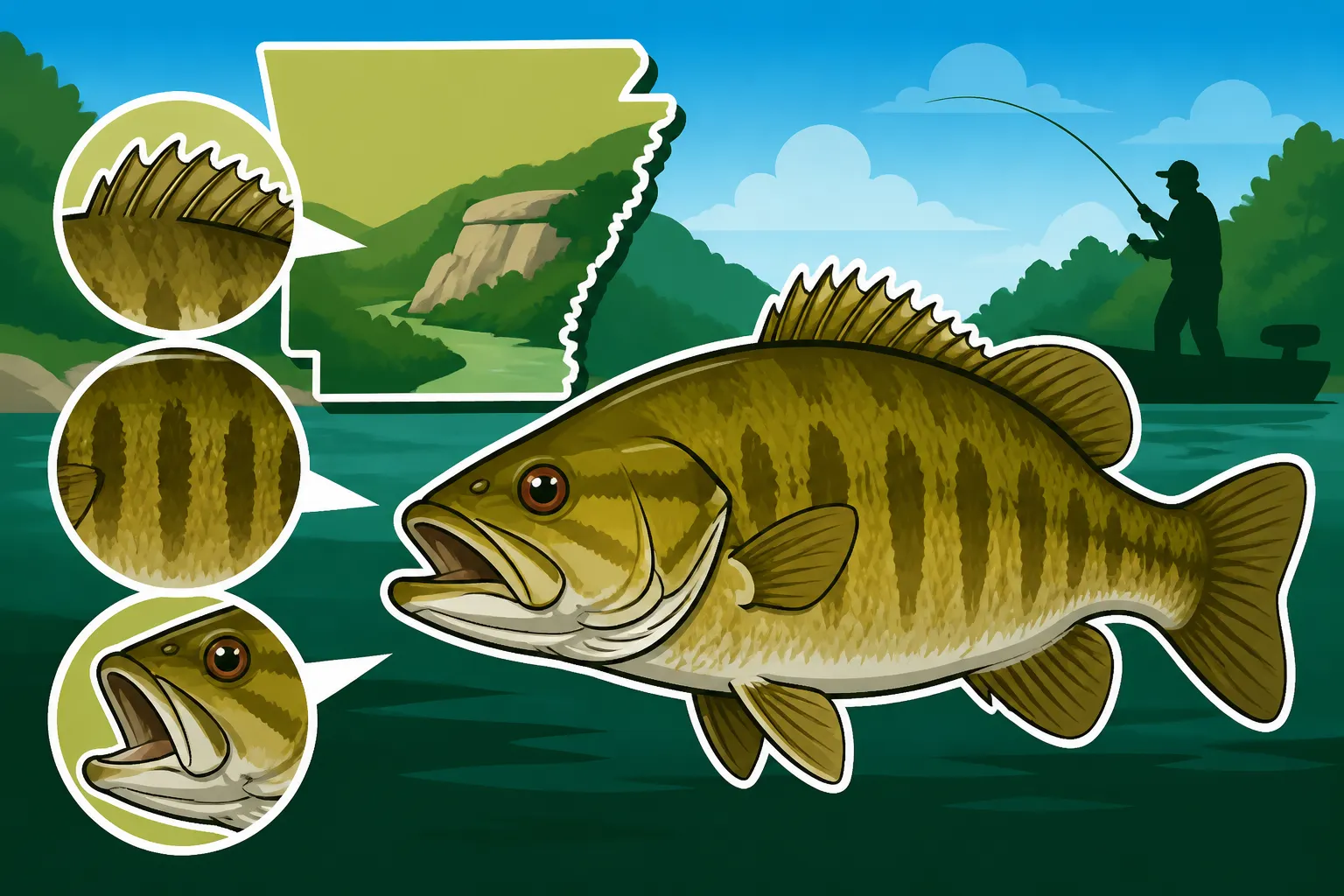
Their coloration is another major giveaway. Smallmouth are famous for their beautiful bronze, golden-brown, or even greenish-brown hues. This isn't a hard and fast rule, as their color can vary depending on the water clarity and bottom composition of their specific environment. Fish from very clear, rocky streams might have a more pronounced bronze, while those from slightly darker waters could lean more greenish. A key pattern to look for are faint vertical bars or blotches along their sides, rather than a distinct, unbroken horizontal lateral line like a largemouth. These bars can sometimes be quite subtle, almost mottled, blending into their bronze background. If you need a side-by-side mental image, checking out How to Identify a Largemouth Bass will give you a good comparison point for body shape and color.
Mouth and Jaw Structure
This is perhaps the single most definitive way to identify a smallmouth bass, and it's a feature that's easy to check right on the water. Gently open the fish's mouth and observe how far back the upper jaw extends. For a smallmouth bass, the upper jaw (or maxillary) will not extend past the back edge of its eye. It will typically stop directly under the middle of the eye or just slightly short of the back edge.
Compare this to a largemouth, where the upper jaw famously extends well past the back of the eye. This anatomical difference is a reliable indicator and one that even novice anglers can quickly learn to spot. It's a quick and easy check, especially if you're using a lip gripper to safely hold the fish for examination. Tools like fish grippers from Amazon can be super helpful for keeping the fish secure and your hands safe while you make this crucial observation.
Dorsal Fin Separation
Another excellent characteristic for identifying a smallmouth bass is the structure of its dorsal fin. Like all black bass, smallmouth have two dorsal fins – a spiny, anterior fin and a softer-rayed, posterior fin. For a smallmouth, these two dorsal fins are clearly separated, often with a noticeable, deep notch between them, almost appearing as two distinct fins.
This separation is much more pronounced than on a largemouth bass, where the two dorsal fins appear nearly continuous, with only a slight indentation. For a Kentucky bass, the separation is also quite noticeable, but often less deep than a smallmouth. Pay close attention to this feature; it's a reliable visual cue that doesn't require you to open the fish's mouth. Knowing this detail can also help when distinguishing between species, as shown in resources like How to Tell a Kentucky Bass from a Largemouth.
Eye Color and Pattern
While not as definitive as the jawline or dorsal fin, the eyes of a smallmouth bass can offer additional clues. They often have reddish or golden-brown eyes, which can sometimes appear quite striking against their bronzed bodies. More distinctively, some smallmouth bass will display radiating patterns or streaks that emanate from their eyes, sometimes described as "teardrop" markings or stripes. These patterns can be faint or quite prominent, depending on the individual fish and its environment. These subtle facial patterns, combined with the other key indicators, form a complete picture for positive identification.
Distinguishing Smallmouth from Other Arkansas Bass Species
When you're out on the water, especially in Arkansas where multiple bass species thrive, the challenge isn't just knowing what a smallmouth looks like, but knowing how to tell it apart from its close relatives. This is where comparisons become incredibly useful.
Smallmouth vs. Largemouth Bass
The largemouth bass is arguably the most recognized bass species in Arkansas, and it's the one most often confused with the smallmouth. However, once you know what to look for, the differences are quite stark.
Mouth Size: As mentioned, the absolute best way to tell them apart is the mouth. For a largemouth, the jaw extends well past the back of the eye. For a smallmouth, it stops at or before the back of the eye. This is your primary diagnostic.
Body Shape: Largemouth bass tend to be deeper-bodied and more robust, built for ambush in cover. Smallmouth are slender and more elongated, perfect for fighting currents.
Coloration and Pattern: Largemouth usually have a prominent, dark, horizontal lateral line that can appear as a continuous stripe or a series of blotches. Their color is typically dark green to olive. Smallmouth are bronze, golden-brown, or even coppery, with faint vertical bars or mottling instead of a solid horizontal line.
Dorsal Fin: The dorsal fins of a largemouth appear almost continuous, with a very shallow dip between the spiny and soft-rayed sections. Smallmouth have a deep, clear separation between their dorsal fins.
Here's a quick comparison table to keep handy:
| Feature | Smallmouth Bass | Largemouth Bass |
|---|---|---|
| Upper Jaw | Ends at or before the back edge of the eye | Extends distinctly past the back edge of the eye |
| Body Shape | More slender, football-shaped, streamlined | Deeper-bodied, robust, sometimes stocky |
| Coloration | Bronze, golden-brown, coppery, with vertical bars | Dark green to olive, often with a distinct horizontal stripe |
| Dorsal Fin | Clearly separated into two distinct fins | Appears nearly continuous with a shallow notch |
| Habitat Incl. | Clear, rocky rivers; cooler lake sections | Warmer, weedy lakes; murky backwaters |
Practicing these quick checks on every bass you catch will make you an expert in no time. For an even deeper dive into these distinctions, revisit Largemouth Bass vs Smallmouth Bass: What's the Difference?.
Smallmouth vs. Kentucky (Spotted) Bass
Kentucky bass, also known as spotted bass, can be particularly tricky because they share some similarities with smallmouth, especially in certain waters. They often inhabit similar rocky, clear water environments as smallmouth, making visual identification challenging for the untrained eye.
The most critical difference, and one you might need to feel for gently, is the presence of a tooth patch on the tongue. Kentucky bass almost always have a small patch of teeth on the center of their tongue, which feels like a rough spot if you gently rub your finger across it. Smallmouth bass generally do not have this patch, or if they do, it's incredibly small and barely perceptible. This is a very reliable indicator!
Other distinctions include:
Lateral Line: Kentucky bass often have distinct rows of dark spots below their lateral line, which can sometimes form a diamond-like pattern. Smallmouth have vertical bars or blotches, not these defined rows of spots.
Body Scale Pattern: Look closely at the scales. Kentucky bass often have small, dark spots on the lower half of their scales below the lateral line, forming a "spotted" appearance that gives them their name.
Mouth Size: While not as extreme as a largemouth, a Kentucky bass's jaw usually extends slightly past the eye, more so than a smallmouth, but not as far as a largemouth. This can be a subtle difference.
Learning to differentiate between these two can be a bit more nuanced than distinguishing from a largemouth, but focusing on that tooth patch is key. If you're fishing in areas like Bull Shoals, where all three species might be present, an article like How to Tell a Kentucky Bass from a Largemouth at Bull Shoals can be especially helpful for narrowing down the possibilities. If you're still unsure about the tooth patch on a fish and need to quickly measure it against a size limit, having a flexible measuring tape or board from Amazon can prevent any ambiguity before release.
Habitat Clues for Identification
While physical characteristics are paramount, never underestimate the power of knowing your fishing grounds. The environment itself can offer strong hints about what species you're likely to encounter.
Smallmouth bass, as we've discussed, are creatures of clear, cool, flowing water. They thrive in rocky rivers, streams, and the cooler, rockier sections of large reservoirs. Think rapids, riffles, gravel beds, and ledges. If you're casting your line into a pristine, current-heavy section of an Ozark river, your chances of catching a smallmouth are significantly higher. This preference for current and rocky structure is a hallmark of the species.
Largemouth bass, on the other hand, are the masters of cover. They prefer warmer, stiller, often murkier waters, hiding among lily pads, submerged timber, weed beds, and docks. If you're pulling a bass from heavy aquatic vegetation in a calm lake cove, chances are it's a largemouth. Kentucky bass often overlap with smallmouth habitats but can tolerate slightly more turbidity and can also be found around points and submerged structures in reservoirs. So, before you even see the fish, knowing the environment can prime you for what you're likely to catch. Delving into Where to Find Smallmouth Bass in Arkansas will give you even more insight into their preferred haunts.
Practical Tips for On-the-Water Identification
The moment of truth arrives when you land a fish. You need to identify it quickly and accurately to ensure you're following regulations and safely releasing the fish if needed.
Observe Immediately After Landing
When you bring a bass to hand, your first few seconds are critical for identification. The fish will still have its most vibrant and distinct coloration. As fish stress or are out of the water longer, their colors can dull or change, making those subtle patterns harder to discern.
Gently but firmly hold the fish, ideally supporting its body with one hand while using a lip gripper or cradling its jaw with the other. This allows you a clear view of its mouth, fins, and body patterns. Minimize its time out of water. A quick glance at the jawline, a check of the dorsal fin, and a quick feel of the tongue (if differentiating from a spotted bass) should be sufficient. When handling fish, especially the feisty smallmouth, using Amazon fish handling gloves can protect both you and the fish from scrapes or accidental slips.
Use Reference Materials
It's a great idea to carry a small, waterproof field guide specific to Arkansas fish species or have a reliable fishing app on your phone that includes identification charts. Sometimes, having a visual aid right there can confirm what you suspect, especially when you're still learning. Many seasoned anglers keep a laminated card with key identifying features in their tackle box or boat.
The "Thumb Test" for Mouth Size
This is a simple, effective, and very popular field test for the jawline. With the fish gently secured, place your thumb at the back edge of the fish's eye. Then, see if the fish's upper jaw extends past your thumb. If it does, you're looking at a largemouth. If the jaw stops at or before your thumb, it's a smallmouth. This quick "thumb test" can be done in seconds and is remarkably accurate.
Know Your Local Regulations
Perhaps the most crucial reason for accurate on-the-water identification is adhering to fishing regulations. In Arkansas, different bass species often have different size and daily limits. For example, Smallmouth Bass Rules on Arkansas's Moving Waters Statewide specify particular lengths, and you might find that the Minimum length for smallmouth bass on flowing waters in Arkansas is different from other species.
If you mistakenly identify a smallmouth as a largemouth, and the smallmouth happens to be under the legal size limit for its species but over the limit for a largemouth (or vice-versa), you could unknowingly be violating the law. This can lead to serious consequences, including fines, as detailed in articles like Penalties for Fishing Without a License in Arkansas. Knowing Why smallmouth bass must be over 12 inches to keep in certain waters isn't just trivia; it's a legal requirement. Always double-check your catch against the current regulations for the specific body of water you're fishing. When in doubt, it's always best to practice catch-and-release, especially if you can't positively identify the fish or ensure it meets legal requirements.
Disclaimer
This article is for general informational purposes only and does not constitute professional advice. Laws, prices and regulations vary by location and change over time. Consult a qualified professional for guidance on your specific situation.