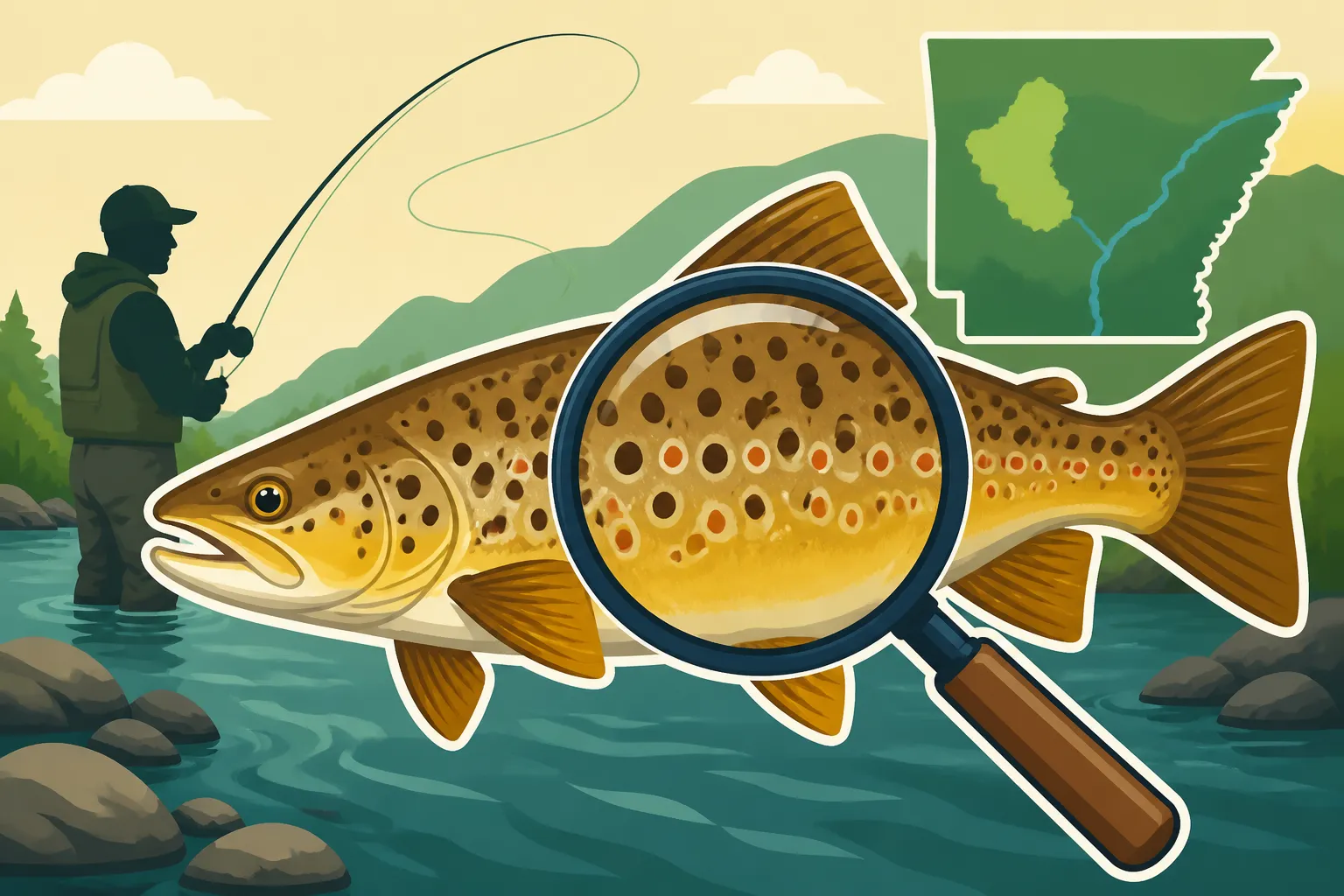
How to Identify a Brown Trout
You've just hooked into a beautiful fish in one of Arkansas's pristine trout streams, and your heart is pounding. But then you wonder, "Is this a rainbow, a brook, or… a brown trout?" It's a common moment of confusion for many anglers, especially when the fish are fresh out of the water and their colors are vibrant and perhaps a little deceptive. Identifying your catch correctly isn't just about satisfying curiosity; it's crucial for adhering to specific regulations that can vary by species and waterbody, especially in sensitive areas like Arkansas's famous trout tailwaters. This guide is here to cut through that uncertainty, giving you the definitive characteristics to confidently identify a brown trout every time you reel one in.
The Distinctive Appearance of a Brown Trout
Brown trout (scientific name: Salmo trutta) are truly magnificent fish, revered by anglers for their striking beauty, challenging fight, and often elusive nature. While they share some similarities with their trout cousins, they possess several key features that, once you know what to look for, make them unmistakable.
Body Shape and Fin Structure
When you hold a brown trout, you'll first notice its robust, somewhat stout, yet streamlined body. It's often described as torpedo-like, built for powerful bursts of speed in strong currents. They tend to be a bit more "thick-bodied" than many rainbow trout of comparable length, especially mature specimens.
Their fins offer some telltale signs. Like all salmonids, they have an adipose fin – that small, fleshy fin located between the dorsal fin and the tail fin. This is a common feature across trout and salmon, so it won't distinguish a brown trout alone, but it confirms you're dealing with a member of the trout family. Pay closer attention to the tail fin. A brown trout's tail fin is typically square or only very slightly forked. It doesn't have the deeply forked tail you might see on a white bass or some other species, nor is it as rounded as some other fish. It's built for stability and power. The dorsal fin is fairly tall and prominent, usually without many distinct markings beyond perhaps a few spots that match the body pattern.
Coloration and Spot Patterns
This is truly the most crucial aspect of identifying a brown trout, and it's where many anglers get tripped up. Brown trout derive their name from their typical base coloration, which can range from a light golden-brown or olive-brown to a darker, almost chocolate brown on their backs, fading to a creamy white or yellowish belly. This color can vary wildly depending on their habitat, diet, and water conditions. Trout from darker, tannin-stained waters might appear much darker, while those from clear, gravelly streams might have a lighter, more golden hue.
The real giveaway, however, lies in their spots. Brown trout are adorned with distinctive spots that are usually larger and fewer in number than those on a rainbow trout. They feature:
- Black Spots: These are scattered across their back, sides, and often on the dorsal and adipose fins. Crucially, these black spots typically have a pale halo or "ring" around them, making them look almost like tiny bullseyes. This halo is a hallmark of the brown trout.
- Red or Orange Spots: This is the other major identifier. Brown trout will almost always have distinct red or orange spots on their sides, particularly along the lateral line. Like the black spots, these red spots are often surrounded by a light, almost iridescent halo. This combination of black spots with halos and red/orange spots with halos is usually all you need to make a positive identification. These red spots are typically absent on rainbow trout.
Unlike rainbow trout, brown trout rarely have any spots on their tail fin. The tail fin will generally be a uniform color, perhaps slightly darker than the body, but free of spots. This is a very reliable distinguishing feature.
Mouth, Jaw, and Teeth
Take a moment to examine the head and mouth of a brown trout. Their mouth is relatively large, extending back to at least the middle of the eye, and sometimes even beyond. Inside, you'll find a formidable array of sharp teeth on both the upper and lower jaws, as well as on the roof of their mouth. These teeth are indicative of their predatory nature, as brown trout are opportunistic feeders that readily consume other fish, insects, and crustaceans.
Perhaps the most fascinating feature, especially on mature male brown trout, is the "kype." During spawning season, male brown trout develop a pronounced, hooked lower jaw that curves upwards. This dramatic change in jaw structure is used in sparring with other males for mating rights. While not present year-round or on all fish (females and juvenile males won't have it), seeing a kype is an absolute confirmation of a male brown trout. It's a truly wild and impressive sight.
Distinguishing Brown Trout from Other Arkansas Trout Species
Arkansas's tailwaters, particularly the White River, are famous for their cold, oxygen-rich waters that support multiple species of trout. This is fantastic for fishing, but it means you're likely to encounter more than just brown trout. The two most common species that get confused with brown trout are rainbow trout and, less frequently, brook trout. Knowing the subtle differences is key.
Brown Trout vs. Rainbow Trout
This is the most common identification challenge in Arkansas. Rainbow trout (Oncorhynchus mykiss) are also abundant in our cold-water fisheries. Here’s a quick breakdown to help you tell them apart:
| Feature | Brown Trout | Rainbow Trout |
|---|---|---|
| Base Color | Golden-brown, olive-brown, or dark brown back; cream/yellow belly | Silvery sides, darker olive or bluish back; white belly |
| Body Shape | Often stockier, more robust | Typically more slender, streamlined |
| Spots | Black spots with light halos; distinct red/orange spots with halos along the lateral line. Spots often larger and less numerous. | Irregularly shaped black spots, typically without halos, scattered over back and sides. No red/orange spots. |
| Lateral Line | Less prominent, often broken by spots | Distinct, often pink or reddish, iridescent stripe along the side (the "rainbow"). |
| Tail Fin | Square or slightly emarginate (shallow fork), no spots. | Moderately forked, covered in numerous small black spots. |
| Mouth/Jaw | Larger mouth, typically extends beyond eye; males develop pronounced kype during spawning. | Smaller mouth, typically not extending past the back of the eye. Males don't develop a kype. |
The lateral line stripe on a rainbow trout is a dead giveaway, even if the "rainbow" coloration isn't super vibrant on a particular fish. This iridescent, often pink or red stripe, running from gill plate to tail, is almost always present to some degree on a rainbow and is never on a brown trout. Similarly, the spotted tail fin of a rainbow is a consistent identifier. If you catch a trout with a heavily spotted tail, it's almost certainly a rainbow. For more in-depth comparison, check out our guide on How to Tell Rainbow Trout from Brown Trout.
Brown Trout vs. Brook Trout
While less common in many of Arkansas's main trout fishing areas compared to rainbows and browns, brook trout (Salvelinus fontinalis) do exist in some colder, high-elevation streams. They are beautiful fish, but technically not a "true" trout (they're actually char).
- Coloration and Pattern: Brook trout are incredibly distinctive. Their backs are usually dark olive or green, covered with intricate, worm-like (vermiculation) patterns that are a lighter green or cream color. They have bright, colorful spots on their sides: red spots with blue halos (often called "halos" or "areolae") and lighter spots.
- Fins: One of the most striking features of a brook trout is its fins. The lower fins (pelvic, anal, and often pectoral) have a distinct white leading edge, followed by a black stripe, and then the reddish or orange fin color. This white leading edge is a definitive characteristic you won't see on a brown or rainbow trout.
- Tail: Their tail is typically square or only slightly forked, similar to a brown trout, but their overall pattern is so different that confusion is rare if you know what to look for.
The "worm tracks" on the back and the bright white leading edges of the lower fins are the primary identifiers for a brook trout, easily distinguishing them from a brown.
Habitat and Behavioral Clues for Identification
Sometimes, where and how you catch a fish can offer valuable hints about its identity, even before you get a good look. Understanding the preferred environments and habits of brown trout can aid in your identification process.
Preferred Habitats in Arkansas
Brown trout are renowned for their preference for cold, clear, well-oxygenated water. In Arkansas, this means they thrive in the state's magnificent tailwater fisheries, particularly the White River below Bull Shoals Dam and the Norfork Tailwater. These rivers maintain consistently cold temperatures year-round due to the deep water released from the dams, creating ideal conditions for trout.
They also appreciate cover. You'll often find brown trout holding near submerged logs, undercut banks, rock piles, and deep pools. They are masters of using structure to ambush prey and hide from predators. When you're fishing areas like the renowned White River, and you're targeting deeper runs or casting near fallen timber, the odds of hooking into a brown trout increase, especially compared to the shallower, faster riffles where rainbows might be more prevalent. This isn't a hard-and-fast rule, of course, as trout can be found anywhere there's food and cover, but it's a useful tendency to note. If you're wondering Where to Find Brown Trout in Arkansas, these deep, structured spots are always a good bet.
Feeding Habits and Behavior
Brown trout are opportunistic and voracious predators. While they certainly feed on aquatic insects like nymphs and midges, especially when young, they are particularly known for their piscivorous (fish-eating) tendencies as they grow larger. This means they'll readily strike at baitfish imitations, larger streamers, or even live bait like minnows. They are often more active feeders during low light conditions, such as dawn, dusk, or even at night, especially the larger, more cautious specimens. Their cautious nature is legendary; trophy brown trout are notoriously wary and can be incredibly challenging to catch.
When you hook a brown trout, their fight is often characterized by powerful runs and deep dives, rather than the spectacular aerial acrobatics often associated with rainbow trout. They use their strong, robust bodies to hold their ground in current, making for an exhilarating battle, particularly on light tackle. Knowing these behaviors can sometimes give you a preliminary guess about what's on the end of your line, further helping your identification when you finally get the fish close. For serious anglers, targeting specific fish with the Best Lures for Brown Trout Fishing can also give you a hint of what you might be reeling in.
Tips for Confident On-the-Water Identification
Even with all the knowledge in the world, identifying a fish quickly on the water can be tricky, especially when you're excited and trying to minimize handling time for a healthy release. Here are some practical tips to help you make a confident identification.
What to Look for Immediately After the Catch
When you've just landed a fish, before you even think about taking a picture or putting it on a stringer (if regulations allow), take a moment for these quick checks:
- Spot Check (Halos & Colors): Is it covered in black spots? Are those black spots surrounded by a lighter ring or "halo"? Do you see distinct red or orange spots, also possibly with halos, along its sides? If yes to these, you're almost certainly holding a brown trout.
- Lateral Line Check: Is there a prominent, often pink or reddish, stripe running along its side? If yes, it's a rainbow. If no, it's leaning towards a brown.
- Tail Fin Check: Is the tail fin speckled with small black spots? If yes, it's a rainbow. If the tail fin is largely clear of spots, it's likely a brown.
- Mouth Size: Does the corner of its mouth extend significantly past the middle of its eye? If so, brown trout have a larger gape.
These four quick observations will usually confirm your identification in seconds. Remember, for proper fish handling, try to keep the fish in the water as much as possible, especially if you plan to release it. Use a rubberized net to minimize slime coat damage and release quickly after identification and any photos.
Using Field Guides and Apps
Even the most experienced anglers can occasionally second-guess themselves, especially when encountering a particularly unique-looking specimen. This is where modern tools can be incredibly helpful.
- Physical Field Guides: Carrying a small, waterproof field guide specific to Arkansas fish species is a fantastic idea. You can find excellent guides on platforms like Amazon that fit right into a tackle box or vest pocket. These guides usually have clear illustrations or photographs, highlighting key identification features. They're reliable and don't require battery life.
- Smartphone Apps: Several fishing identification apps are available for smartphones. While you might not always have cell service in remote areas, many apps store their data offline. These can be incredibly useful for quickly cross-referencing features. Just be mindful of keeping your phone dry!
- Online Resources: Before your trip, familiarize yourself with images of all common trout species in Arkansas. A quick search for Arkansas Fish Species: A Complete Guide to What's Swimming in Your Waters or specific comparisons like How to Tell Rainbow Trout from Brown Trout can be immensely helpful. The more you look at different examples, the better you'll become at recognizing the subtle variations.
The key is to learn the primary characteristics. Once you know to look for those haloed spots and the clear tail, identifying a brown trout becomes second nature. It will also help you appreciate just how special these fish are, especially the Trophy Brown Trout Records on the White River that many anglers dream of catching.
Understanding the regulations associated with each species is also critical. For instance, length limits or creel limits might differ between brown trout and rainbow trout on certain sections of river, so correct identification isn't just a fun fact, it's a necessity for responsible angling. Always double-check the latest Arkansas Game and Fish Commission regulations before heading out.
Happy fishing, and may your next brown trout be a memorable one!
Disclaimer
This article is for general informational purposes only and does not constitute professional advice. Laws, prices and regulations vary by location and change over time. Consult a qualified professional for guidance on your specific situation.